Let’s address the elephant in the room right away: Artificial intelligence is not here to steal your blueprints, take your job, or magically design a multi-family complex in a single click. What it is here to do, however, is take away the mind-numbing, repetitive tasks that keep you at the office until 2 AM. If you are an architect, real estate developer, or interior designer working in the United States today, you already know that the industry has fundamentally shifted. We have moved from fearing the rise of artificial intelligence in architecture to actively scaling our businesses with it.
The best AI tools for architects in 2026 include platforms for generative design, automated rendering, and site analysis, such as Finch 3D, Veras, and TestFit. By leveraging the top AI tools for architects, US-based firms are cutting down feasibility studies from weeks to hours, generating floor plans instantly, and turning basic 3D geometry into stunning conceptual art in seconds. Whether you are sketching a luxury home in Miami or developing a mixed-use high-rise in Chicago, embracing workflow automation for architects is no longer optional; it is the baseline for staying competitive. Let’s dive into the ultimate guide to the 10 best AI tools for architects that are redefining how we design, build, and sell in 2026.

The Visual Revolution: AI in Conceptualization
Every great project starts with a spark. In the past, creating mood boards and early-stage concepts meant spending days scouring Pinterest or sketching by hand. Today, the most popular AI tools for architects are completely revolutionizing the early-stage design process, allowing you to generate breathtaking visual representations of your ideas in mere minutes. This is the era of AI for architectural concept design.
Tool 1: Midjourney v6/v7
Remember the dreaded blank canvas syndrome? Midjourney completely obliterates it. As the ultimate mood-board generator, Midjourney is an absolute must-have among AI tools for architects and interior designers. By typing a simple text prompt, you can generate hyper-realistic conceptual images of building facades, interior lighting scenarios, and landscape designs. It is the perfect tool to bring to a first client meeting when you want to establish a vibe, explore different aesthetic directions, and get immediate visual buy-in before you even open your CAD software.

Tool 2: LookX AI
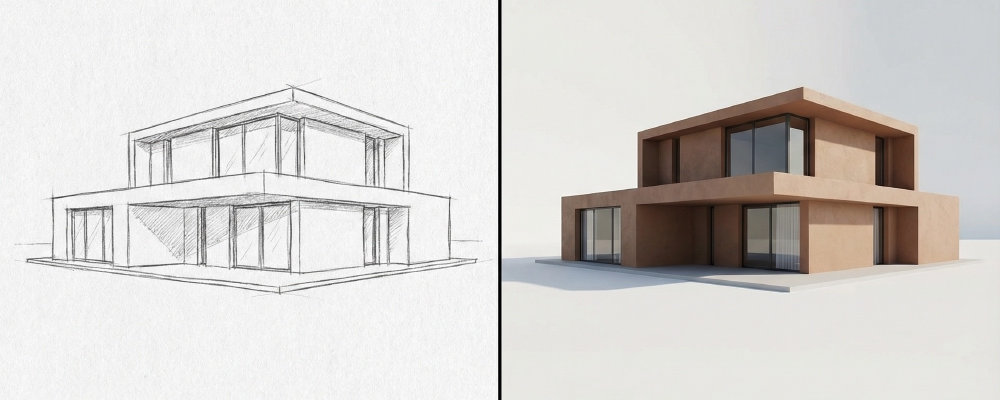
If Midjourney is the wild, unrestricted artist, LookX AI is the disciplined professional. Unlike generic image generators, LookX was trained specifically on architectural geometry and structural logic. This means it actually understands what a building should look like. You can upload a simple sketch, a massing model, or a clay render, and LookX will generate realistic material applications, environmental lighting, and structural details that make sense. When it comes to specialized AI tools for architects, LookX bridges the gap between raw imagination and architectural reality.
Seeing these tools generate stunning concepts in a matter of seconds inevitably brings up the industry’s biggest anxiety: are we designing our own replacements? We dive deep into the reality of job security, human creativity, and the future of the AEC industry in our comprehensive analysis: Will AI Replace Architects?.
Generative Design & Floor Planning
Once the initial mood is set, it is time to focus on the math, the spatial logic, and the flow of the building. This is where AI tools for architects move from pretty pictures to heavy lifting. If you are a residential architect or a home builder, the following platforms will save you hundreds of hours of manual drafting.
Tool 3: Finch 3D
Finch 3D is rapidly becoming one of the most talked-about AI tools for architects who deal with complex floor plans. Using generative design, Finch optimizes floor plans instantly based on your building footprints and local constraints. Imagine dragging the walls of your building envelope and watching the interior rooms, corridors, and structural grids automatically adjust and recalculate in real-time to maintain optimal spatial efficiency. It is nothing short of magic for maximizing usable square footage.
Tool 4: Autodesk Forma (formerly Spacemaker)
For urban planners and architects working on larger-scale developments, Autodesk Forma is the heavyweight champion. Forma allows you to run complex wind, sun, daylight, and noise simulations in seconds. Instead of waiting until the end of the design phase to see if your building creates a wind tunnel on the street below, Forma gives you predictive analytics right from the start. It is one of the most essential AI tools for architects focused on sustainable, data-driven design in dense urban environments.
Tool 5: Maket.ai
Maket.ai is a phenomenal resource tailored specifically for residential home builders and interior designers. It allows you to generate customized residential floor plans based on specific client constraints (like plot size, number of bedrooms, and budget). Furthermore, it lets you explore endless style variations and material finishes with a single click. When evaluating AI tools for architects, Maket stands out for its user-friendly interface and its direct application to the booming US custom home market.

The Developer’s Toolkit: Feasibility & Compliance
Let’s pivot to the business side of building. Real estate developers, project managers, and lead architects care deeply about ROI, site viability, and avoiding catastrophic zoning mistakes. The most lucrative AI tools for architects are the ones that mitigate risk and accelerate the pre-development phase.
Tool 6: TestFit
Time is money, and nowhere is that more true than in real estate development. TestFit is the ultimate generative design tool for rapid site feasibility studies. You input the parcel data, and TestFit immediately calculates building massing, parking ratios, yield, and financial viability in real-time. Instead of waiting three weeks for a feasibility report to decide if a piece of land in Texas is worth buying, developers and architects can run the numbers and see the 3D massing in a single afternoon. When we discuss ROI-driven AI tools for architects, TestFit is at the top of the list.
Tool 7: UpCodes Copilot
Navigating complex US building codes is nobody’s favorite task. Enter UpCodes Copilot. This AI-powered search engine and compliance assistant is an absolute lifesaver. You can ask it highly specific questions about the International Building Code (IBC) or specific state regulations, and it will give you accurate, cited answers. It prevents costly compliance errors and endless hours of flipping through codebooks. Every firm should have UpCodes on their roster of daily AI tools for architects.

Workflow Automation & AI Rendering Plugins
The best software doesn’t force you to change how you work; it enhances the software you already use. The next category of AI tools for architects focuses on direct plugins that live right inside your favorite programs like Revit, SketchUp, and Rhino.
Tool 8: Veras (by EvolveLAB)
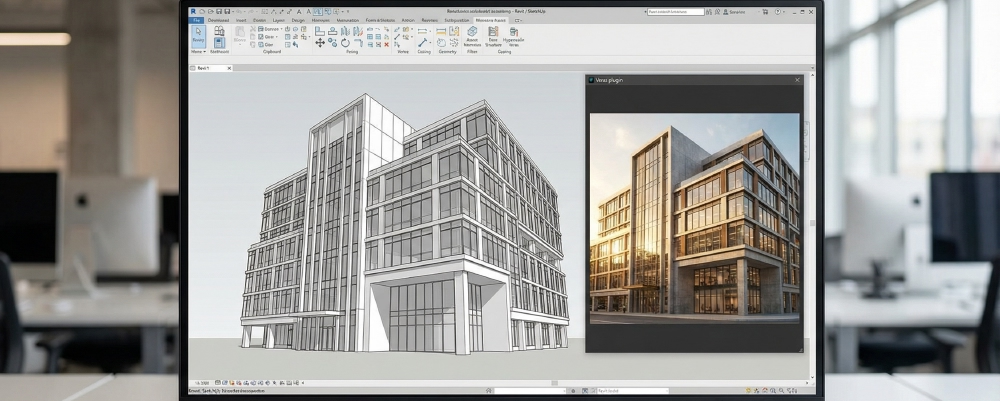
You have a basic massing model in SketchUp or Revit, and your client needs to see a conceptual render by the end of the day. Veras is the answer. It is an AI-powered rendering plugin that uses your existing 3D geometry to generate quick, stunning conceptual renders based on text prompts. It is an incredible asset for rapid visual prototyping, making it one of the most popular AI tools for architects who need speed without leaving their BIM environment.
Tool 9: D5 Render (AI features)
When we talk about the evolution of architectural visualization, D5 Render is pushing the envelope. While inherently a real-time rendering engine, D5 has integrated incredibly powerful AI features, including AI atmosphere generation and smart material matching. It takes the heavy lifting out of lighting setups, allowing architects to produce cinematic, high-quality walkthroughs of their projects with unprecedented ease.
Tool 10: ChatGPT / Claude (Custom AEC GPTs)
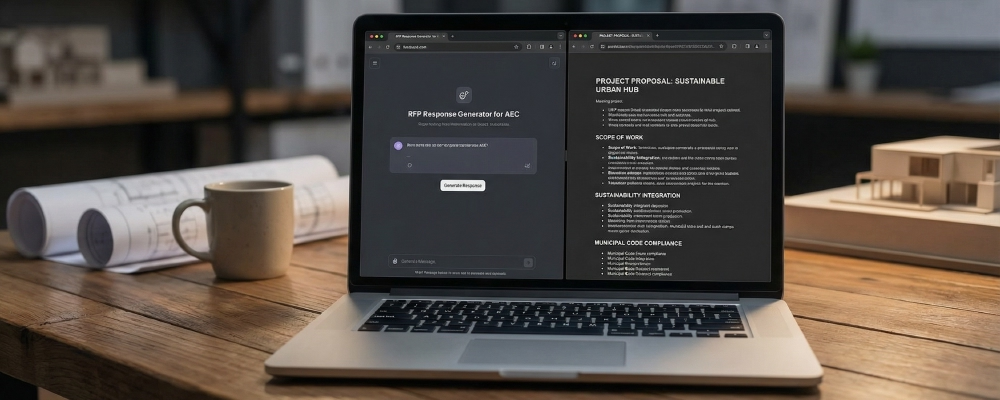
We cannot talk about AI tools for architects without mentioning the heavy hitters: OpenAI’s ChatGPT and Anthropic’s Claude. While not visual, these Large Language Models are the ultimate engines for workflow automation for architects. From writing persuasive project proposals and formatting complex RFPs, to summarizing meeting notes and automating client emails, creating custom GPTs trained on your firm’s data is the ultimate productivity hack.
Bridging the Gap: From AI Dream to Construction Reality
Here is the reality check: AI is absolutely incredible for the conceptual phase. It gives you 10 brilliant ideas in 10 minutes. It breaks creative blocks, calculates parking lots, and generates beautiful mood boards. But artificial intelligence cannot generate a fully clash-detected, construction-ready 3D model, nor can it create the pixel-perfect, hyper-realistic marketing assets needed to sell a multi-million dollar luxury development.
This is the crucial distinction when using AI tools for architects: AI can spark the vision, but bringing that vision to life requires precise engineering and clash-free modeling. When your AI concepts are approved and ready to become buildable, profitable realities, our BIM Building and professional 3D Rendering services step in. We ensure that every pipe, wall, and wire is perfectly coordinated for your contractors and investors. True BIM (Building Information Modeling) AI integration means using AI for the concept, and professional human expertise for the execution.
If you have a project in mind let us know here.
Frequently Asked Questions
-
Will AI replace architects and interior designers?
No. The best AI tools for architects act as powerful co-pilots designed to handle tedious, repetitive tasks. This workflow automation for architects allows professionals to focus heavily on creative problem-solving, human empathy, and client relations, things a machine simply cannot replicate. If you want to learn more about this topic visit our article Will AI Replace Architects?.
-
What is the best AI tool for architectural floor plans?
Currently, AI tools for architects like Finch 3D and Maket are leading the industry for generative floor plan layouts. They allow designers to input specific constraints and instantly receive optimized, space-efficient floor plan variations. However, AI lacks the nuanced understanding of real-world human flow and complex structural realities. It is always best practice to have a human expert verify and refine these layouts. At Xpress Rendering, our team provides the professional oversight and BIM modeling services needed to ensure your AI-generated plans are not just mathematically efficient, but fully practical, compliant, and ready for construction.
-
How do real estate developers use AI?
Developers rely on highly analytical AI tools for architects and builders, such as TestFit, for rapid site feasibility. These tools calculate ROI, zoning analysis, and parking yields in real-time, allowing developers to make informed purchasing decisions before buying land.
-
Can AI integrate directly into Revit or SketchUp?
Yes, absolutely. Plugins like Veras and Autodesk Forma allow professionals to generate AI renderings and run complex environmental simulations directly within their existing 3D modeling software, bridging the gap between basic drafting and advanced AI capabilities.
-
Is AI rendering good enough for final client presentations?
While visual AI tools for architects are fantastic for early mood boards and conceptual exploration, final marketing materials and construction presentations still require the precision, control, and hyper-realism of professional 3D rendering and dedicated BIM services.
-
Are AI-generated architectural designs copyrightable?
As of 2026, US copyright laws generally require human authorship for a work to be protected. Therefore, designs created entirely by AI tools for architects usually serve as high-level inspiration rather than legally protected, final architectural blueprints.
Conclusion
The landscape of building design has fundamentally changed, but it has changed for the better. The top AI tools for architects are not a passing trend; they are a permanent upgrade to how the industry operates. From Midjourney’s striking visual concepts to TestFit’s rigorous financial feasibility algorithms, these platforms empower professionals to design faster, smarter, and with greater precision than ever before.
If you are feeling overwhelmed by the sheer volume of new technology, don’t try to master everything at once. Pick just one of the AI tools for architects from this list, perhaps Veras for your SketchUp workflow or ChatGPT for your proposal writing, and test it out this week. The future of the AEC industry belongs to those who adapt. Embrace the tools, automate the mundane, and get back to doing what you do best: designing incredible spaces.
Ultimately, the true power of these AI tools for architects does not lie in replacing the human touch, but in elevating it. Algorithms can calculate parking yields and generate striking concept art, but they cannot sit across from a developer, understand the emotional weight of a community space, or intuitively catch a complex structural clash before it happens on site.
Human verification, emotional intelligence, and real-world architectural intuition remain entirely irreplaceable. That is exactly why industry leaders partner with Xpress Rendering. We harness the speed of artificial intelligence for rapid ideation, but it is our team of seasoned human professionals who provide the rigorous oversight, precise BIM coordination, and hyper-realistic 3D rendering required to turn a digital concept into a profitable, buildable reality.
Let the AI handle the mundane calculations; partner with us to bring your masterpiece to life.