Summary: The Vessel NYC Architecture in 60 Seconds
Quick answer: The Vessel NYC architecture is a climbable public landmark at Hudson Yards in Manhattan, designed by Thomas Heatherwick and Heatherwick Studio as an interactive structure made of interconnected staircases, landings, and viewing platforms.
- Location: Hudson Yards, Manhattan, New York City.
- Designer: Thomas Heatherwick / Heatherwick Studio.
- Main idea: A public landmark that people move through, not just look at.
- Design inspiration: Indian stepwells and the visual rhythm of repeated stairs and landings.
- Scale: Roughly 2,500 steps, 154 flights, 80 landings, and 16 storeys.
- Architecture lesson: Iconic public design must balance spectacle, safety, accessibility, maintenance, and human experience.
- Why it matters: The project shows how architecture, public space, real estate branding, and user experience can work together inside a major urban development.
The Vessel NYC architecture is what happens when a staircase decides it wants to become a landmark, a workout, a selfie magnet, and an urban debate all at once. It is part sculpture, part observation experience, part public-space experiment, and part “wait, are we really climbing all of that?” moment.
Located at Hudson Yards in Manhattan, The Vessel was designed by Thomas Heatherwick and Heatherwick Studio as an interactive public landmark meant to be entered, explored, photographed, questioned, and discussed. And yes, people have definitely discussed it. A lot.
But this article is not a tourist checklist. This is an architecture case study for architects, developers, builders, interior designers, real estate professionals, and anyone interested in how a bold design object can shape public space, branding, movement, and urban identity. We will look at The Vessel NYC architecture through the lens of design ambition, user experience, construction logic, safety, public responsibility, and the visual communication needed to make complex projects understandable before they are built.
Why The Vessel NYC Architecture Still Matters
The Vessel NYC architecture still matters because it sits at the intersection of design, development, tourism, public space, and civic conversation. In other words, it is not just an object in the middle of a plaza. It is a design decision with real consequences.
Heatherwick Studio was invited to create a public centerpiece for Hudson Yards, a major development built over a rail yard on Manhattan’s West Side. The goal was not simply to add a nice sculpture between towers. The goal was to create a social landmark that people could physically engage with. According to Heatherwick Studio’s Vessel project page, the project was developed as something that could be climbed and explored, lifting people above the public square and revealing views across the Hudson River and Manhattan.
For architects and developers, that is the first lesson: a successful landmark is not only about form. It is about behavior. The Vessel NYC architecture asked visitors to move, pause, look, climb, photograph, and interact with each other. The building experience became the design feature.
What Is The Vessel NYC?
A quick definition for architects, developers, and curious New Yorkers
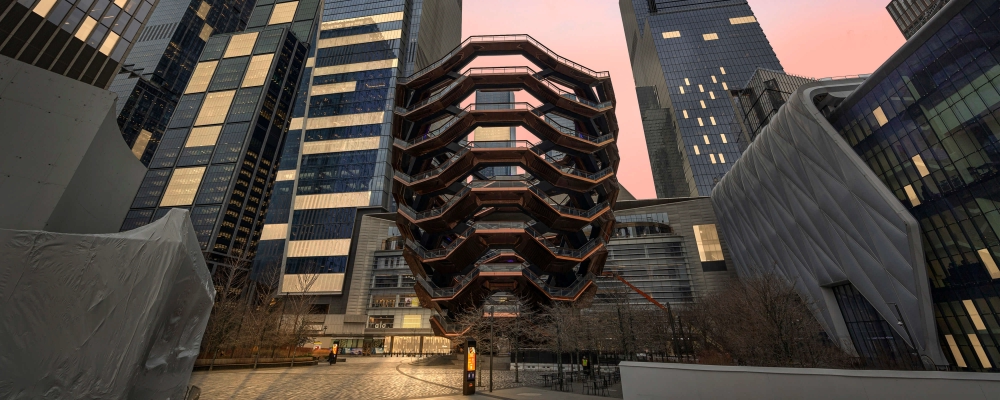
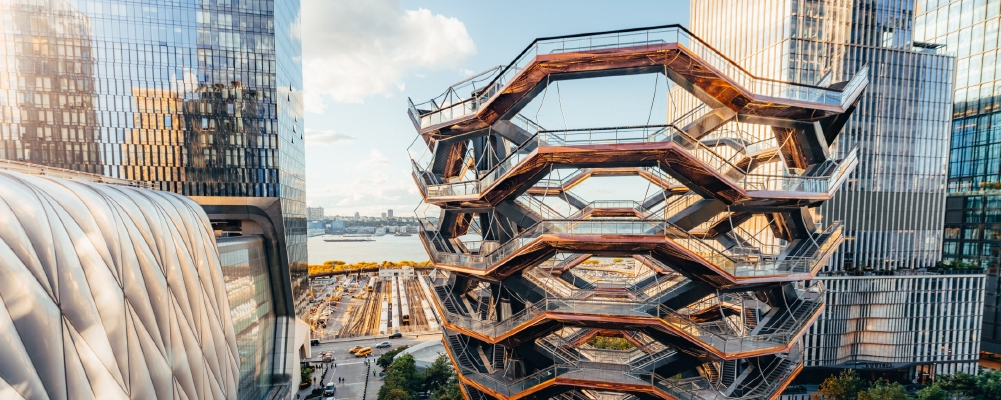
The Vessel NYC is an interactive public landmark located at Hudson Yards in Manhattan. Designed by Thomas Heatherwick and Heatherwick Studio, it is composed of interconnected stairs, flights, platforms, and viewing points. It functions as a sculptural object, an urban lookout, a circulation experience, and a public-space attraction.
The official Vessel NYC website describes it as one of New York City’s most photographed locations, offering a unique visual experience from every angle and a moving reflection of its urban surroundings. That is a very important phrase for design professionals, because it shows that Vessel NYC design is not only about geometry. It is about perception.
And perception matters. A developer may call it “place-making.” A realtor may call it “marketability.” An architect may call it “spatial experience.” A visitor may call it “the giant copper staircase thing.” Somehow, everyone is correct.
The Big Idea Behind The Vessel NYC Architecture
A public landmark you do not just photograph; you move through
The strongest idea behind The Vessel NYC architecture is that it turns circulation into the main event. Most buildings hide stairs in emergency cores, service zones, or quiet back-of-house areas. The Vessel does the opposite. It puts the stair in the spotlight and says, “This is the architecture.”
That is what makes the project interesting as an interactive public landmark. It is less of an object and more of a choreographed urban climb. Visitors move up and down. They cross paths. They look across the void. They see the same city from different levels. They become part of the image.
For architects, this is a useful reminder: movement can be a design concept. Not just a code requirement. Not just a diagram arrow. Not just the thing that happens after the rendering is approved. In The Vessel NYC architecture, circulation is the story.
For developers, the lesson is equally practical. A strong public-space feature can create a destination moment inside a larger master plan. It gives people a reason to enter, gather, share, and remember the place. In a crowded city like New York, memorable is not a luxury. It is survival with better lighting.
Design Inspiration: Indian Stepwells, Repetition, and Urban Drama
How ancient spatial logic became a futuristic NYC landmark
One of the most fascinating parts of The Vessel NYC architecture is its relationship to historical precedent. Heatherwick Studio has described the design as being influenced by the Indian stepwells of Rajasthan, where repeated stairs and landings create powerful spatial depth, rhythm, and visual movement.
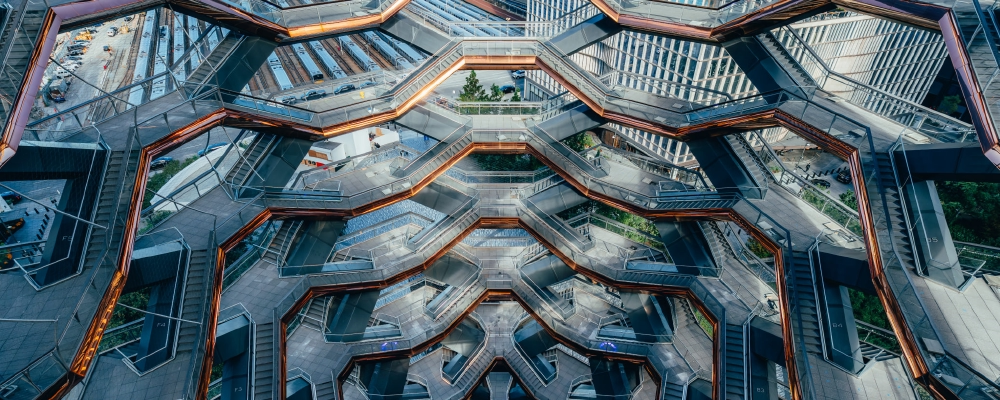
That reference matters because it shows how old architectural ideas can be reinterpreted in contemporary urban contexts. The Vessel is not a literal stepwell. It does not descend into the earth. It rises above a plaza. But it borrows the hypnotic logic of repetition: stair, landing, stair, landing, turn, view, pause, repeat.
For architects and interior designers, this is where The Vessel NYC architecture becomes a lesson in visual rhythm. Repetition can create drama. Geometry can create identity. Material can amplify experience. When those ingredients work together, even a very simple element, like a stair, can become a full architectural narrative.
This is also why The Vessel NYC design reads so strongly in photographs. The repeating flights and platforms create a pattern that feels both mathematical and theatrical. It is precise enough for architects to study and dramatic enough for visitors to post before finishing their coffee.
The Vessel NYC Architecture at a Glance
Quick facts for search visibility
| Detail | Information |
|---|---|
| Project | The Vessel NYC |
| Location | Hudson Yards, Manhattan, New York |
| Architect / Designer | Thomas Heatherwick / Heatherwick Studio |
| Completion | 2019 |
| Height | 16 storeys / approximately 150 feet |
| Main Experience | Interconnected stairs, landings, and city views |
| Design Inspiration | Indian stepwells |
| Material Expression | Steel structure with copper-colored underside |
| Development Context | Hudson Yards mixed-use district |
Different sources describe the exact stair count slightly differently. Heatherwick Studio references 2,500 steps, 154 flights, 80 landings, and 16 storeys, while ArchDaily describes it as a 16-storey public landmark with 2,465 steps and 80 landings. For a reader-friendly article, “roughly 2,500 steps” is the safest wording. It keeps the focus on the architectural point: The Vessel NYC architecture is basically a vertical maze that went to design school.
Hudson Yards: Why Location Makes The Vessel NYC Architecture More Important
The landmark inside a larger real estate machine
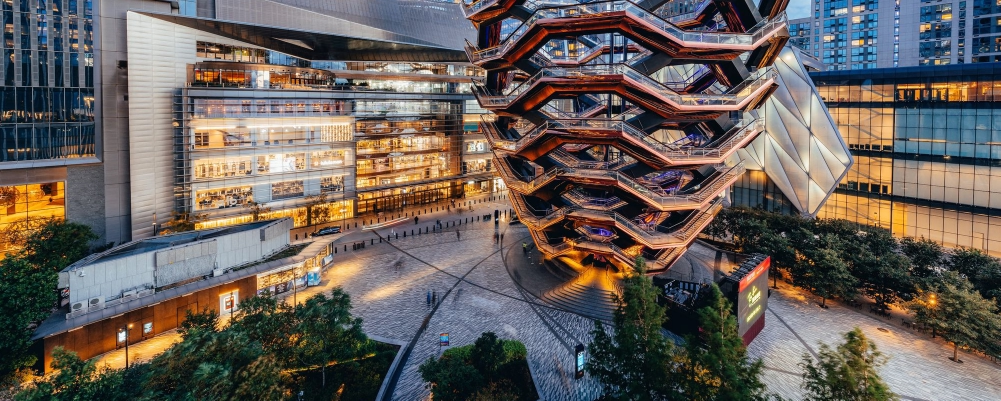
You cannot fully understand The Vessel NYC architecture without understanding Hudson Yards. The structure is not floating in architectural space like a museum model under perfect lighting. It sits inside one of the most ambitious real estate and urban development efforts in New York City.
The broader Hudson Yards initiative has been described by NYCEDC’s Hudson Yards overview as a transformation of 360 acres of underutilized land on Manhattan’s Far West Side into a mixed-use destination with office space, residences, retail, transportation access, waterfront views, and cultural capital.
That context changes everything. Vessel Hudson Yards is not just a sculptural attraction. It is a branding device, a public-space anchor, and a visual identity marker for a large mixed-use district. In real estate terms, it gives the development a recognizable center. In urban design terms, it creates a destination point. In everyday human terms, it gives people a place to say, “Meet me by the shiny staircase.”
For a broader look at how New York landmarks shape skyline identity, explore Xpress Rendering’s New York Buildings Guide, which breaks down famous NYC structures and their architecture highlights. It pairs well with this discussion because The Vessel NYC architecture belongs to a larger family of New York architecture landmarks that influence how people read the city.
Architecture as Experience: What Makes The Vessel NYC Architecture So Photogenic?
Geometry, reflections, movement, and the “Instagram effect”
The Vessel became famous quickly because it is visually easy to recognize. That is not an accident. The Vessel NYC architecture uses repetition, symmetry, reflection, and vertical perspective to create images that feel strong from almost every angle.
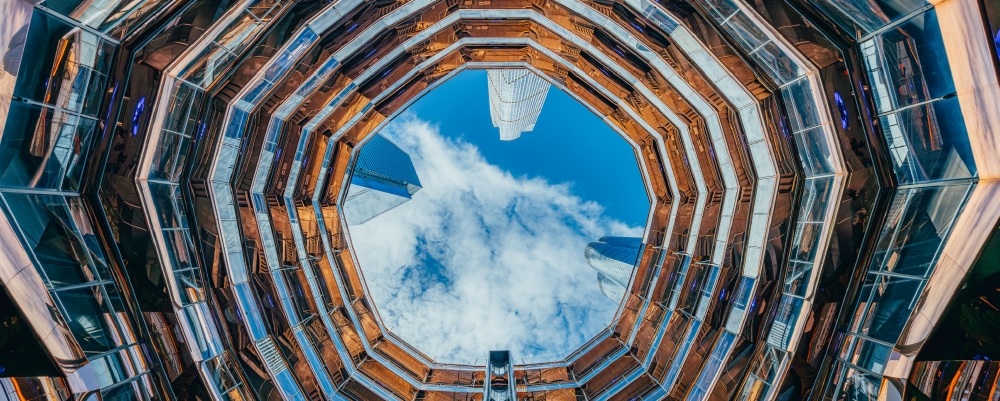
From below, the structure frames the sky. From the side, it reads like a copper-toned honeycomb. From inside, it becomes a layered field of stairs, bodies, shadows, and reflections. From above, it becomes a pattern. It is the kind of project that makes photographers happy and calves nervous.
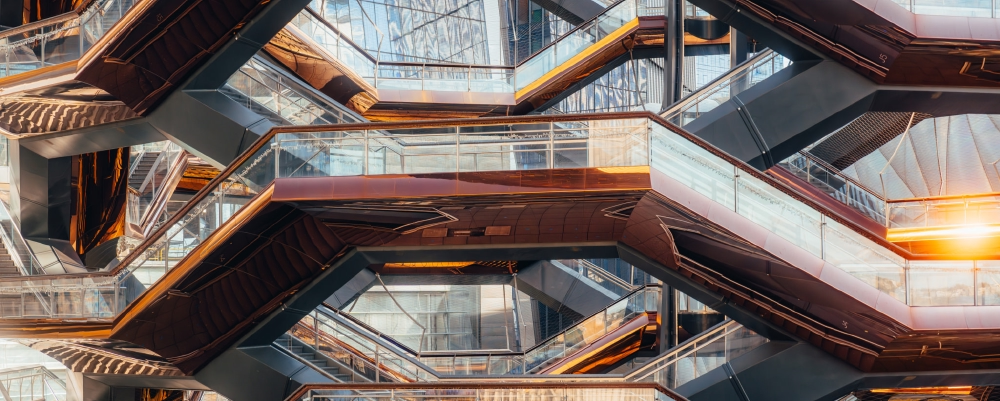
The copper-colored underside is especially important. It reflects the surrounding city and adds warmth against the glassy, high-rise environment of Hudson Yards architecture. For interior designers, this is a lesson in material atmosphere. For developers, it is a lesson in brand memory. For architects, it is a reminder that a surface is never just a surface when it is placed in the public eye.
In that sense, The Vessel NYC architecture understands the modern city very well. People do not only experience architecture in person. They experience it through images, reels, videos, articles, maps, travel lists, investor decks, and digital presentations. A project with a strong visual hook travels further.
Structure and Buildability: The Hidden Discipline Behind the Drama
Why complex forms need serious coordination
Although The Vessel NYC architecture looks like a sculptural gesture, it required highly disciplined engineering, fabrication, and assembly. That is the hidden reality behind most iconic architecture: the more effortless it looks, the more coordination probably happened behind the scenes.
According to project descriptions from Heatherwick Studio and architecture publications, Vessel was fabricated in Venice, Italy, by specialist steel fabricator Cimolai, then transported and assembled in New York. ArchDaily also notes that large steel components were produced off-site and assembled at Hudson Yards.
This matters to builders and developers because it highlights a very practical truth: ambitious design depends on buildability. A beautiful concept is not enough. Complex geometry needs documentation, sequencing, engineering logic, fabrication tolerance, and a construction strategy that does not collapse into chaos by Monday morning.
That is why The Vessel NYC architecture is useful as a case study beyond its appearance. It reminds teams that iconic outcomes require integrated thinking. Architects, engineers, fabricators, owners, builders, consultants, and visualization teams all need to understand the same design intent.
Public Space Lessons from The Vessel NYC Architecture
Lesson 1: A landmark should create behavior, not just attention
A public landmark can be photogenic and still fail if people do not know what to do with it. The strongest part of The Vessel NYC architecture is that it gives visitors an action: climb, explore, pause, look, descend, repeat. It converts attention into movement.
For architects, that is a reminder to design for behavior. For developers, it is a reminder that successful destinations are not only about square footage. They are about what people remember doing there.
Lesson 2: The ground plane is part of the brand
Many projects treat the plaza as leftover space after the main building has taken the budget, the glory, and the good coffee machine. The Vessel shows why that is risky. The ground plane is not empty space. It is the first impression.
The entry sequence, pedestrian approach, surrounding retail, sightlines, shade, seating, and gathering zones all shape how people perceive The Vessel NYC architecture. For NYC public space architecture, the ground plane can make a project feel open, confusing, inviting, premium, cold, energetic, or forgettable.
Lesson 3: Scale needs a human counterweight
Hudson Yards is surrounded by tall buildings, glass surfaces, and large development gestures. In that context, Vessel adds a human-scaled activity, even though the object itself is large. People can touch it, climb it, photograph it, and understand it with their bodies.
This is an important lesson for large developments. A tower may define the skyline, but a public experience defines memory at street level. The Vessel NYC architecture shows how a smaller landmark can compete emotionally with much larger buildings.
Lesson 4: Iconic design comes with public responsibility
Not every public-space lesson is comfortable, but the uncomfortable ones are often the most important. The Vessel NYC architecture also became part of a safety conversation after it closed due to serious public safety concerns. It later reopened with added safety measures, including steel mesh barriers on parts of the structure.
For architects, developers, and operators, this is a major reminder: public architecture does not end at opening day. It continues through use, maintenance, management, adaptation, feedback, and risk assessment.
Lesson 5: Architecture is also communication
If people do not understand how to enter, move, gather, rest, or safely use a space, the design loses power. The Vessel NYC architecture communicates through form, but every public project also communicates through signage, access rules, ticketing, security, lighting, digital information, and operational design.
Architecture is never just the object. It is the full experience around the object.
The Safety Conversation: A Necessary Chapter in The Vessel NYC Story
What architects and developers can learn from the reopening
Any serious discussion of The Vessel NYC architecture must include its safety chapter with care and respect. The Vessel closed after tragic incidents and later reopened with additional safety measures. In October 2024, AP reported that the structure would reopen with floor-to-ceiling steel mesh barriers installed on parts of it, while the top level remained closed and tickets were required.
This should not be treated as gossip or controversy bait. For professionals, it is a post-occupancy lesson. Public projects need to consider not only how people are expected to use a space, but how people might actually behave in complex emotional, social, and urban conditions.
Great public architecture does not end at opening day. It must evolve with responsibility. The Vessel NYC architecture now represents both design ambition and the need for public-space systems that are safer, clearer, and more adaptable over time.
The Vessel NYC Architecture and the Future of Public Landmark Design
Should every major development have a signature public object?
Here is the honest answer: no, not every major development needs its own Vessel. Please do not put a giant staircase in every mixed-use project in America. The suburbs are not ready.
But every major development does need a memorable experience. That experience may be a plaza, a lobby, a rooftop, a courtyard, a pedestrian paseo, a public art element, an amenity deck, a hospitality moment, or a beautifully designed arrival sequence.
The key lesson from The Vessel NYC architecture is not “build a sculptural stair.” The lesson is: create a clear spatial identity. Give people a reason to remember the place. Make the experience understandable, photographable, functional, safe, and connected to the larger development story.
For home developers and real estate teams, that can translate into better amenity design, stronger pre-sales visuals, more convincing investor presentations, and spaces that buyers can emotionally connect with before they ever sign a contract.
From The Vessel NYC to 111 West 57th Street: Two Different Ways to Become Iconic
New York City has many ways of turning architecture into identity. The Vessel NYC architecture becomes iconic through movement, public interaction, and sculptural repetition. 111 West 57th Street, on the other hand, becomes iconic through extreme verticality, skyline presence, and engineering precision.
If The Vessel NYC is about movement through public space, 111 West 57th Street is about how extreme slenderness can become a luxury identity. One is a public landmark you climb. The other is a supertall residential icon you read from across the skyline.
Together, they show a useful truth about New York architecture: the city rewards strong ideas. A project does not become memorable by accident. It needs a clear concept, disciplined execution, and a visual story strong enough to survive the noise of the city.
Visualization Takeaway: Why Projects Like The Vessel Need Strong 3D Rendering
Before a landmark is built, someone has to believe in it
The Vessel NYC architecture is a reminder that ambitious architecture is not only designed; it is communicated. Before a public landmark, mixed-use development, luxury tower, residential community, or commercial space earns attention in the real world, stakeholders need to understand the vision clearly.
That is where professional 3D rendering becomes more than a presentation tool. It becomes a bridge between concept, approval, marketing, and construction confidence. For architects, renderings help defend design intent. For developers, they support investor conversations, pre-sales, leasing, and approvals. For interior designers, they communicate atmosphere, materiality, lighting, and experience. For builders, they reduce misunderstandings and help teams align before decisions become expensive.
Bring Your Project Vision to Life Before It Is Built
If you are planning a residential, commercial, mixed-use, hospitality, or real estate development project, Xpress Rendering can help you communicate the design with professional 3D renderings, animations, and architectural visualization services tailored for presentations, marketing, approvals, and client decision-making.
Conclusion: The Vessel NYC Architecture Is a Design Lesson, Not Just a Landmark
The Vessel NYC architecture may look like a staircase that got ambitious, but for architects and developers, it is really a case study in how form, movement, branding, public space, and responsibility collide in one unforgettable urban object.
Its value is not only in its copper-colored surfaces or dramatic geometry. Its value is in the questions it raises. How do we create landmarks people can actually use? How do we make public space memorable without making it complicated? How do we balance spectacle with safety? How do we communicate ambitious ideas before they become expensive realities?
For architects, designers, builders, developers, and real estate professionals across the United States, The Vessel NYC architecture offers a practical lesson: iconic design needs more than a bold shape. It needs a strong concept, a clear user experience, coordinated execution, operational responsibility, and visual storytelling powerful enough to help people believe in the project before it exists.
The Vessel NYC Architecture FAQs
1. What is The Vessel NYC?
The Vessel NYC is an interactive public landmark located at Hudson Yards in Manhattan. Designed by Thomas Heatherwick and Heatherwick Studio, it is made of interconnected staircases, flights, platforms, and landings that visitors can enter and explore.
2. Where is The Vessel NYC located?
The Vessel NYC is located in Hudson Yards on Manhattan’s West Side, near the High Line, The Shed, Edge, shops, restaurants, offices, and residential towers.
3. Who designed The Vessel NYC?
The Vessel NYC was designed by Thomas Heatherwick and Heatherwick Studio as a central public landmark for Hudson Yards.
4. Why is The Vessel NYC architecture famous?
The Vessel NYC architecture is famous for its honeycomb-like geometry, copper-colored reflective surfaces, interconnected staircases, and its role as a highly photographed public landmark in Hudson Yards.
5. How many steps does The Vessel NYC have?
The Vessel NYC is commonly described as having roughly 2,500 steps, 154 flights of stairs, 80 landings, and 16 storeys. Some sources cite 2,465 steps, so “roughly 2,500” is the safest general wording.
6. What inspired The Vessel NYC design?
The Vessel NYC design was inspired by Indian stepwells, especially the repeated stair flights and platforms that create a powerful spatial and visual experience.
7. Is The Vessel NYC open to visitors?
The Vessel NYC official website currently presents ticketed visitor experiences. Because hours, tickets, access levels, and safety rules can change, visitors should check the official Vessel NYC website before planning a visit.
8. What can architects learn from The Vessel NYC architecture?
Architects can learn how circulation can become the main design concept, how public landmarks can create identity for mixed-use developments, and why safety, accessibility, operations, and user behavior must be considered from the earliest design stages.