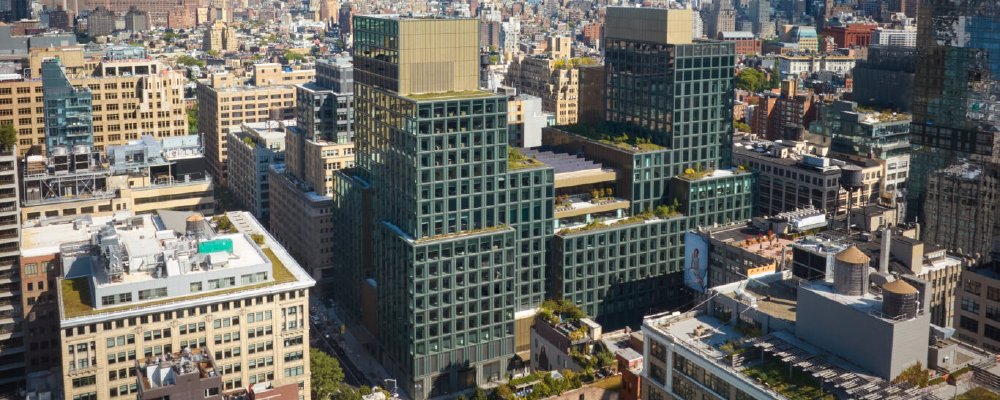
When a global media giant decides to move, it doesn’t just sign a lease: it reshapes a neighborhood. That is exactly what happened with the Disney New York Headquarters at 7 Hudson Square. After more than a century of storytelling in New York, The Walt Disney Company consolidated its scattered operations into a single, purpose-built, all-electric, terracotta-clad headquarters that occupies an entire city block in Lower Manhattan. It is part media machine, part workplace, part urban statement.
According to Disney’s official project page, the new headquarters is conceived as a collaborative “town square” for its New York teams, a vertical campus where newsrooms, studios, streaming, technology, and creative offices coexist in one place.
In this article, we will explore the Disney New York Headquarters architecture as a case study in contemporary corporate design. We will look at how the Robert A. Iger building fits into the history of Disney in New York, how it responds to the evolving character of Hudson Square, and what architects, developers, interior designers, and real estate professionals can learn from it.
If you design, develop, or market buildings for a living, this is not just another pretty headquarters. It is a real-world example of how to align brand, context, sustainability, and user experience in one coherent architectural story.
Quick Facts: Disney New York Headquarters at a Glance
Before we dive into the nuances, here is a quick snapshot of the project.
-
Official Name: Robert A. Iger Building – Disney New York City Headquarters
-
Common Name: Disney New York Headquarters, 7 Hudson Square
-
Location: 7 / 4 Hudson Square (137 Varick Street), Hudson Square, Lower Manhattan, New York City
-
Owner: The Walt Disney Company
-
Architect (Base Building): Skidmore, Owings & Merrill (SOM)
-
Interior Architect: Gensler
-
Landscape Architect: SCAPE
-
Height: Approximately 320 feet (roof)
-
Stories: 19 office stories
-
Gross Floor Area: Around 1,200,000 square feet
-
Site Area: About 85,600 square feet (full city block)
-
Program: Offices, newsrooms, TV studios, live audience studios, screening room, reading room, café, terraces, wellness and amenity spaces
-
Completion: Construction completed 2024–2025, with phased move-in of ABC, ESPN, and other Disney divisions
-
Sustainability: All-electric building, targeting and achieving LEED BD+C Core & Shell Platinum and LEED ID+C Platinum
For architects and developers, this “stats page” alone already tells you a lot: massive floorplates, a highly technical program, tight urban context, and very high sustainability ambitions.
Disney and New York City: A Century-Long Story Behind the Headquarters
From Steamboat Willie to Hudson Square
Disney did not just show up one day in Lower Manhattan with a checkbook and a zoning study.
New York has been woven into Disney’s history since the very beginning. In 1928, Steamboat Willie, the short that essentially launched Mickey Mouse, premiered in Manhattan. Decades later, Disney played a starring role at the 1964–65 New York World’s Fair, where attractions like it’s a small world and other animatronic-driven exhibits previewed the immersive experiences that would later define Disney parks.
Broadway further anchored the company in the city’s cultural fabric. Starting with Beauty and the Beast in the 1990s and followed by long-running hits like The Lion King and Aladdin, Disney Theatrical helped reshape Times Square and cemented Disney as a cultural force in New York, not just a distant Hollywood studio.
Seen through that lens, the Disney New York Headquarters is not an isolated project. It is the latest chapter in a relationship that spans cinema, theater, theme park innovation, and now, contemporary workplace and media architecture.
The Robert A. Iger building is also personal inside the company. Named after Robert A. Iger, who began his career at ABC in New York in the 1970s, the headquarters celebrates a long arc of media history while looking squarely toward the future.
Why Hudson Square? From Printing District to Media Hub
Choosing Hudson Square was not a random site selection exercise. It was a strategic move.
Historically, Hudson Square was a district of printing houses and loft buildings, robust structures with large floorplates, high ceilings, and industrial character. Over time, as printing declined, these buildings were repurposed as creative offices, studios, and galleries. Zoning changes then opened the door to new mixed-use developments with larger footprints and taller massing, catalyzing the neighborhood’s transformation into a hub for media and tech.
Disney seized the opportunity in 2018, signing a long-term ground lease on the site and committing to build a headquarters that would consolidate news, production, streaming, and corporate operations under one roof. The result is a full-block building that does two things at once:
-
It fits within the industrial DNA of the neighborhood.
-
It signals a new phase of Hudson Square as a 21st-century media district.
For architects and urban designers, Hudson Square is a case study in how zoning, legacy building stock, and corporate investment combine to reinvent a neighborhood, and Disney New York Headquarters is one of the clearest physical expressions of that change.
Standing Out by Fitting In: Massing, Urban Design, and Skyline Presence
A Full-City-Block Vertical Campus
One of the most remarkable aspects of the Disney New York Headquarters is simply its footprint. The building fills an entire block bounded by Vandam Street to the north, Varick Street to the east, Spring Street to the south, and Hudson Street to the west.
For designers used to threading towers onto slender sites, this kind of footprint is rare territory in Manhattan. It allows SOM to approach the project not just as a tower, but as a vertical campus.
Inside that footprint, the building stacks a dense mix of uses:
-
TV studios and technical spaces at the lower levels, some buried below grade.
-
Newsrooms, broadcast studios, and editorial floors in the middle band.
-
Corporate offices, support spaces, and terraces at the upper levels.
ABC, ESPN, ABC News, and other Disney divisions that were previously scattered across the city now share this single address. The Disney headquarters becomes a “mini city” where production, editorial, technology, and leadership circulate in the same ecosystem.
For developers, the lesson is clear: when you have the rare chance to control a full block, you can do more than just maximize rentable area. You can choreograph circulation, relationships between brands, and long-term flexibility in a way that is almost impossible in a typical point tower.
Wedding-Cake Setbacks and Twin Towers
Given that footprint, SOM had a challenge: how do you avoid creating a single, bulky slab that overwhelms the neighborhood?
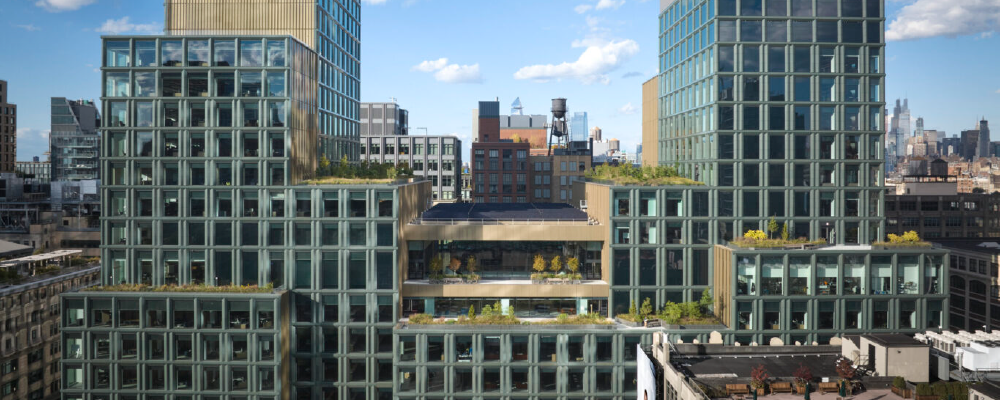
Their answer is a massing strategy that recalls New York’s historic setback “wedding cake” zoning profile. The base rises several stories and then steps back in tiers as it climbs, culminating in two symmetrical towers at the east and west ends of the site, each around 320 feet tall.
These setbacks accomplish several things at once:
-
They reduce the perceived bulk of the Disney New York Headquarters from street level.
-
They open up space for terraces and outdoor rooms.
-
They create a valley-and-peak silhouette that feels distinctly urban and undeniably contemporary.
The result is a building that feels robust but not aggressive. From a distance, the twin volumes and stepped profile echo the water towers and warehouse roofs of Lower Manhattan, connecting Disney’s new headquarters to a long lineage of New York massing – from Rockefeller Center to Black Rock and beyond.
For architects working on large floorplate projects, this is a powerful reminder: even when you have a lot of area to stack, the way you articulate volume can determine whether your building becomes a neighborhood villain or a surprisingly good neighbor.
The Green Terracotta Façade: Materiality, Rhythm, and Context
Terracotta That Nods to Copper and Masonry
If you have seen photos of the Disney New York Headquarters, you probably remember one thing first: the façade.
Rather than a generic glass curtain wall, SOM chose a skin of large-format, lichen-green terracotta columns framing deeply recessed windows. The vertical members are grouped in double and triple clusters, creating a rhythmic texture across the elevation. In sunlight, the glazed terracotta takes on an iridescent quality, shifting tone throughout the day.
This choice is not just aesthetic. It is contextual.
Hudson Square is full of brick, masonry, and stone buildings, some with copper detailing that has weathered to green over time. By using green terracotta, the Disney headquarters references those materials in a contemporary way. The building “speaks” the neighborhood’s language but with a new accent.
The effect is a façade that:
-
Feels substantial and crafted, not flimsy.
-
Balances warmth and modernity.
-
Provides strong vertical lines that break down the overall scale.
For façade designers, the Robert A. Iger building is a compelling example of how to use terracotta in a way that is both technical and expressive, especially on a project with massive surface area and high performance requirements.
Human Scale at the Street
The façade strategy is not only about what happens 300 feet up. It is also about how people experience the Disney New York Headquarters at the sidewalk.
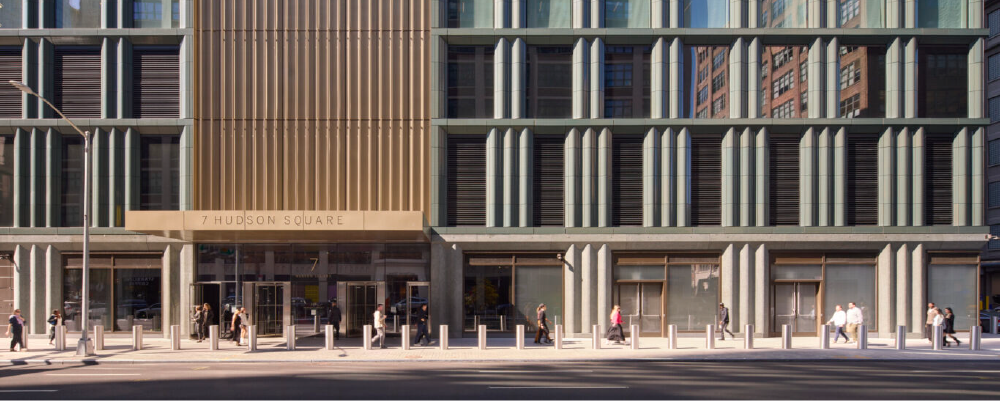
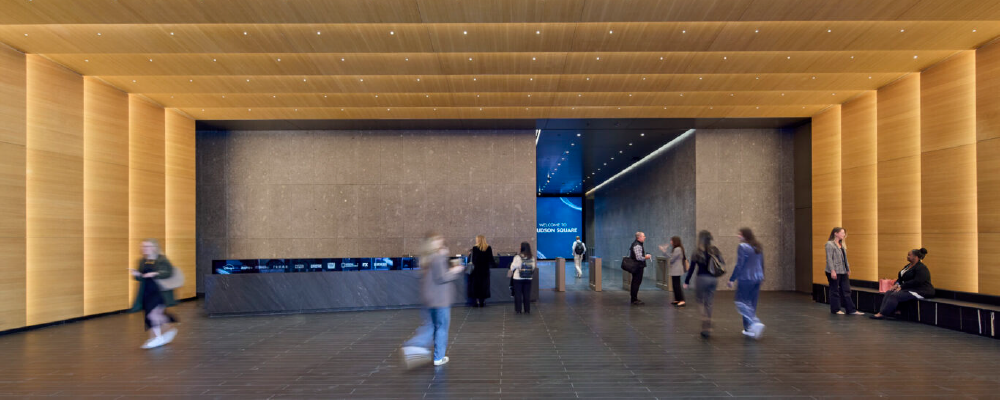
At the base, the terracotta is complemented by exposed structural concrete with a slight green tint and large, inviting openings. Retail spaces, canopies, and lobby entrances are sculpted as smooth, fluid cuts into the mass, softening the building’s presence at eye level.
This matters for two reasons:
-
Hudson Square is not a central business district of mirrored glass. It is a neighborhood of lofts, galleries, and creative offices. The ground floor has to contribute to street life, not shut it down.
-
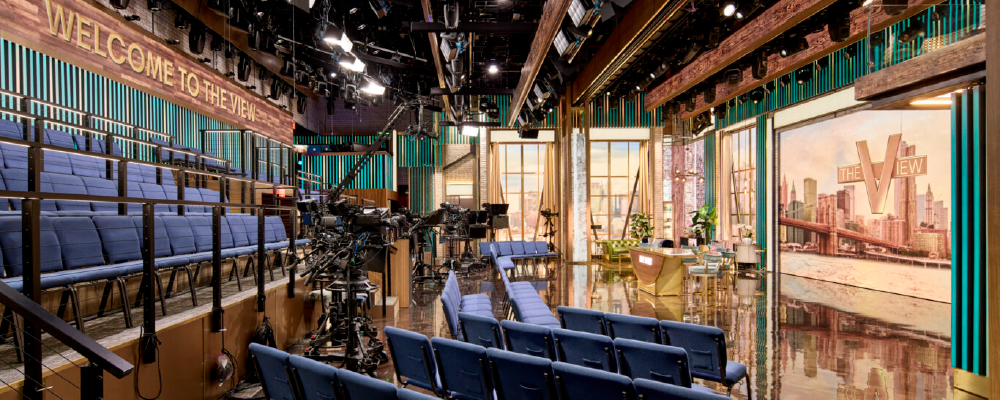
For a building that welcomes studio audiences for shows like The View and other ABC productions, the base needs to handle crowds comfortably, with generous lobbies and queuing areas that keep people off the sidewalk and out of the rain.
For interior designers and retail architects, the lesson is clear: even in a heavily branded corporate headquarters, the street-level experience should feel like an extension of the neighborhood, not a security perimeter around it.
Brand Storytelling in Space: Interiors by Gensler and Disney’s Visual Identity
Workplaces Designed for Hybrid Creativity
If SOM focused on form, façade, and technical infrastructure, Gensler concentrated on what it means to work inside the Disney New York Headquarters day-to-day.
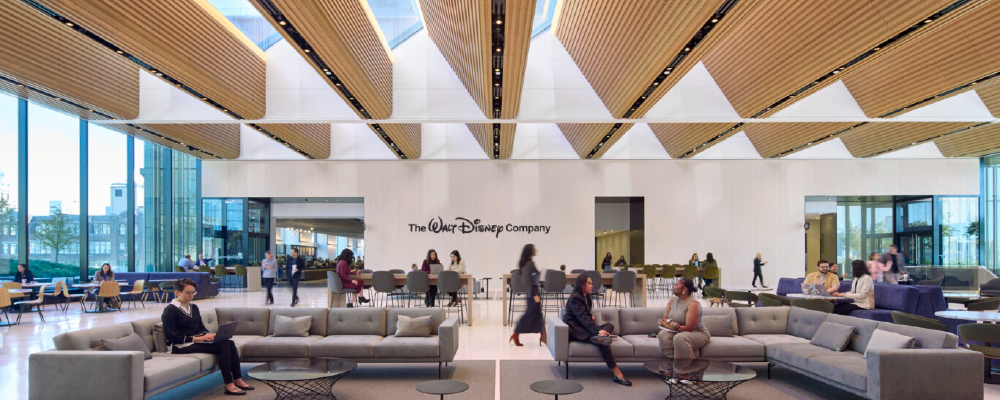
The result is an interior that treats the building as a “content creation engine.” Almost anywhere, you can imagine filming, recording, or capturing some form of media. That means flexible layouts, power and data everywhere, and a variety of work settings – from focused rooms to collaborative lounges – that can double as backdrops.
Instead of a binary division between “office” and “studio,” the headquarters blurs the line:
-
Lower floors lean more technical and equipment-heavy, supporting sound stages and production.
-
Middle and upper floors are more open and office-like, but still ready for rapid content creation and broadcasting.
From a design standpoint, this is what modern workplace planning looks like for media and tech: every square foot has to work both as a place to think and a place to produce.
Luminous Frames, Archives, and Mickey in Bronze
The Disney New York Headquarters would not feel like Disney without visual storytelling woven into the architecture.
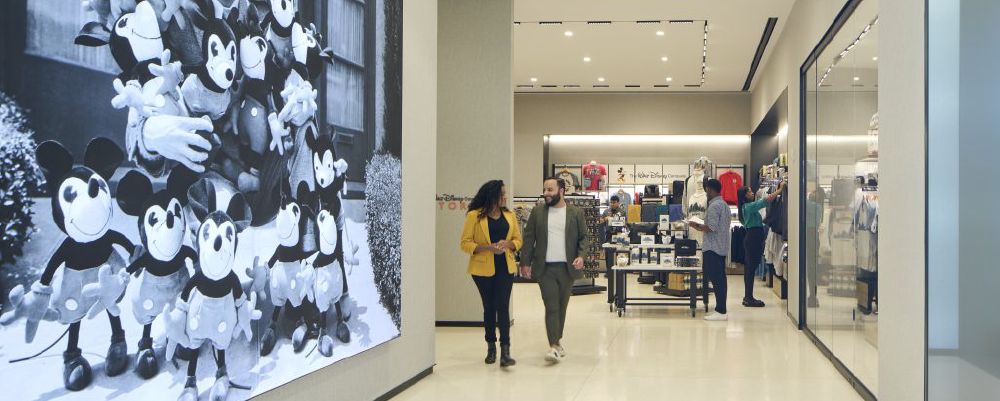
SOM’s graphics and brand team, working closely with Disney Corporate Creative Resources and the Disney Archives, developed a system of luminous image frames that display stills from across the company’s long history. These appear along circulation routes and in key gathering spaces, doubling as wayfinding and narrative devices.
Other brand-driven elements include:
-
A “Legends and Luminaries” gallery celebrating notable figures from Disney’s family of brands.
-
A sculptural Mickey Mouse in mirrored bronze, casually posed rather than theme-park literal.
-
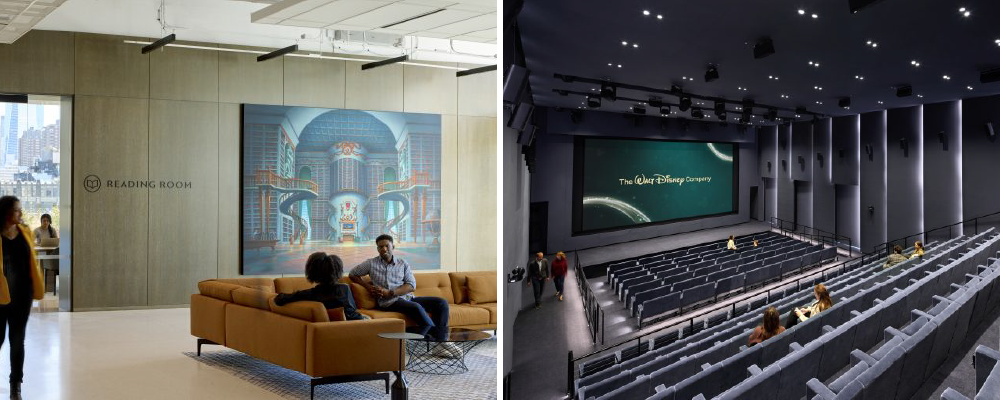
A reading room curated with artifacts and imagery that trace Disney’s evolution from modest beginnings to a global media powerhouse.
-
A café lined with large-scale reproductions of early film posters.
The signage and typography throughout the Disney headquarters pull from the streamlined modernism of Disney’s historic Burbank studio, updated for a contemporary environment.
For designers interested in branded environments, this project is a masterclass in restraint. It proves you do not need character cut-outs at every corner. When architecture, interiors, and graphics are aligned, the brand comes through in tone, material, and experience – not just logos.
All-Electric, LEED Platinum, and Beyond: Sustainability as Strategy
The Greenest Building at Its Scale?
Disney New York Headquarters is not just visually “green” because of its terracotta. It is also functionally green.
The building is designed as an all-electric facility. It relies on high-efficiency heat pumps, dedicated outdoor air systems, waste heat recovery, and a high-performance envelope to reduce energy consumption and support New York City’s push away from on-site fossil fuels. On-site solar panels contribute renewable energy, and the project targets aggressive energy code performance, exceeding local baselines.
On the certification side, the Disney headquarters pursues and achieves:
-
LEED BD+C Core & Shell Platinum
-
LEED ID+C Platinum
For owners and developers, this reinforces a broader trend: sustainability at this level is no longer a nice-to-have marketing point. It is a risk management strategy, a recruiting advantage, and increasingly a compliance requirement in cities with strict carbon legislation.
Terraces, Daylight, and Well-Being
Sustainability here is not only about systems and certifications. It is also about how people feel in the building.
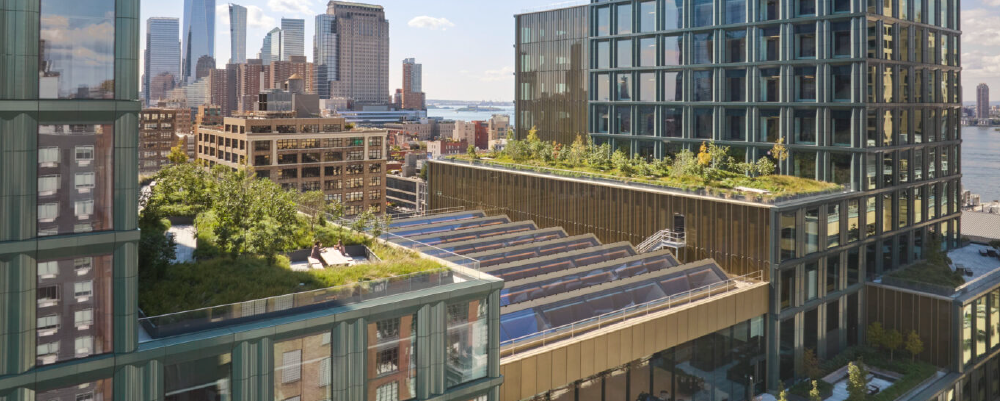
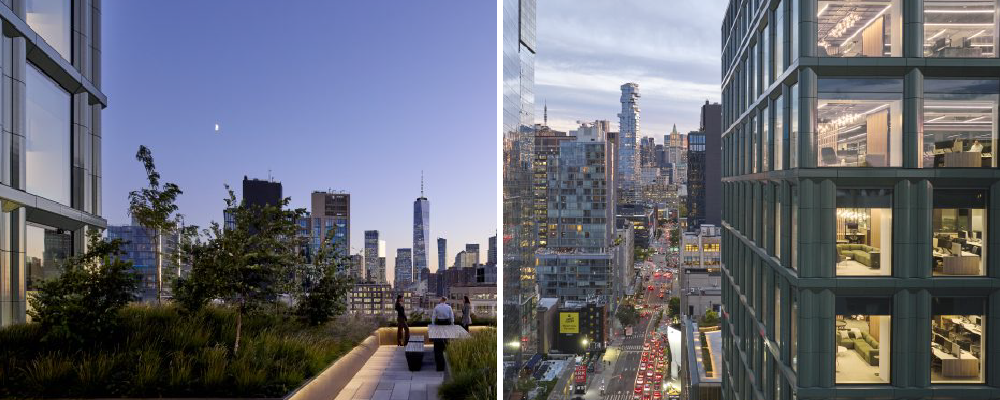
SCAPE designed a series of landscaped terraces and green roofs at multiple setbacks across the Disney New York Headquarters, giving employees access to outdoor spaces with views over Lower Manhattan’s water towers, rooftops, and the Hudson River corridor.
Combined with:
-
Generous daylight from deep window recesses and the sawtooth roof in the Great Room,
-
Amenity spaces like wellness rooms, screening rooms, a bike room with showers, and a full-service café,
the building supports health and well-being as integral parts of its design.
For architects and interior designers, this is a valuable reminder: “sustainable” and “healthy” can be aligned through physical access to nature, carefully managed daylight, and amenity planning that actually reflects how people work and recharge.
What Architects, Developers, and Interior Designers Can Learn from Disney New York Headquarters
For Architects
For architects, the Disney New York Headquarters is a reminder that context still matters, even in an era of global brands and Instagram-famous buildings.
Key takeaways:
-
You can work at massive scale and still respect neighborhood character by carefully shaping massing, setbacks, and street-level experience.
-
Terracotta and other “old” materials can feel highly contemporary when used in bold geometries and high-performance systems.
-
Complex programs – studios, newsrooms, offices – can be integrated into a single, legible architectural idea rather than expressed as disconnected parts.
If your next project involves a large corporate client in a sensitive neighborhood, Disney’s approach at 7 Hudson Square offers a powerful precedent.
For Developers and Owners
From a developer or owner’s point of view, the Disney headquarters makes a strong case for thinking beyond the typical office tower.
Lessons include:
-
A vertical campus model can consolidate leases, streamline operations, and create stickier workplaces that people actually want to use.
-
Investing in sustainability upfront (all-electric systems, LEED Platinum) helps future-proof an asset against changing regulations and energy costs.
-
Architecture and brand alignment is not just “PR value.” It directly influences talent attraction, retention, and the perceived quality of the workplace.
In a market where high-performing tenants have many options, buildings like the Robert A. Iger building show what it takes to stand out.
For Interior Designers and Workplace Strategists
For interior designers and workplace strategists, the Disney New York Headquarters reinforces several key principles:
-
Hybrid environments – part broadcast facility, part office, part event space – are becoming more common. Flexibility is a baseline requirement, not a bonus.
-
Creating a strong “central gathering space” like the Great Room is essential in large, multi-tenant or multi-division buildings. It gives the project a social anchor.
-
Brand storytelling can be integrated with restraint and sophistication through curated art, subtle graphics, and thoughtful material choices rather than over-branding.
If your clients are moving toward content creation, live streaming, or immersive experiences, thinking the way Disney and Gensler did here will help you stay ahead of the curve.
Bringing Projects Like Disney’s to Life Visually: 3D Rendering as a Design and Marketing Tool
A project like the Disney New York Headquarters does not appear fully formed on a trace paper sketch. It moves through countless iterations, reviews, and approvals – from planning departments and community boards to executives, broadcasters, and investors.
If you are working on your own “vertical campus”, whether it is a media headquarters, a mixed-use tower, or a creative workpla, these visual tools can make the difference between a project that feels abstract on paper and one that everyone understands and believes in.
At Xpress Rendering, our 3D Rendering Services are designed for exactly this kind of challenge. We help architects, developers, and interior designers turn complex design ideas into persuasive, photo-realistic imagery that supports design decisions, marketing efforts, and approvals. If you are ready to visualize your next project with the same clarity and emotion you see in projects like the Disney New York Headquarters, explore our 3D Rendering Services page and let’s talk about your vision.
FAQs: Disney New York Headquarters Architecture
-
What is Disney New York Headquarters and where is it located?
Disney New York Headquarters is the consolidated New York City base for The Walt Disney Company and several of its divisions, including ABC and ESPN. It is located at 7 Hudson Square (137 Varick Street) in the Hudson Square neighborhood of Lower Manhattan, occupying an entire city block.
-
Who designed the Disney New York Headquarters architecture at Hudson Square?
The base building architecture for the Disney New York Headquarters was designed by Skidmore, Owings & Merrill (SOM). Gensler led the interior architecture and workplace design, while SCAPE designed the terraces, green roofs, and streetscape.
-
When was the Disney New York Headquarters completed?
Construction of the Disney New York Headquarters at 7 Hudson Square was substantially completed in 2024, with phased occupancy and full operational use rolling out through 2025 as ABC News, ESPN, and other Disney operations migrated into the building.
-
Why is the Disney New York Headquarters covered in green terracotta?
The green terracotta façade references the masonry and aged copper tones common in Hudson Square and nearby neighborhoods, while giving the building a distinct contemporary identity. The vertical terracotta columns and deep window recesses create texture, depth, and a strong connection to the district’s industrial heritage.
-
How tall is the Disney New York Headquarters and how many stories does it have?
The Disney New York Headquarters rises to roughly 320 feet in height, with about 19 primary office stories plus additional technical and mechanical levels at the top. The stepped massing culminates in two prominent towers on the east and west ends of the site.
-
What makes the Disney New York Headquarters a sustainable, all-electric building?
The building is designed as an all-electric facility, using high-efficiency heat pumps, advanced ventilation systems, and high-performance façades. It incorporates on-site solar panels, waste heat recovery, and bird-safe glazing, and it targets LEED BD+C Core & Shell Platinum and LEED ID+C Platinum, aligning with Disney’s 2030 environmental goals and New York City carbon regulations.
-
How is the interior of Disney’s New York Headquarters organized for media production and offices?
Lower levels host large broadcast studios, technical rooms, and production infrastructure. Above them sit newsrooms, editorial floors, and additional studios, many housed in double-height spaces. Upper levels offer offices, collaborative workplaces, and terraces, while the central Great Room acts as a communal hub and event space that connects the two towers.
-
What can architects and developers learn from the Disney New York Headquarters architecture for their own projects?
Architects and developers can learn how to balance large-scale program needs with sensitive urban context, how to express brand identity without resorting to superficial theming, and how to use sustainability as a design driver. The Disney New York Headquarters shows that you can deliver a highly technical, media-rich building that still feels like a good neighbor and a timeless piece of the city’s fabric.
Conclusion: A New Model for Corporate Headquarters in the 21st Century
The Disney New York Headquarters at 7 Hudson Square is more than an address change. It is a case study in how architecture, urban design, workplace strategy, and sustainability can converge in a single project.
In one building, you see:
-
A clear respect for the industrial character and scale of Hudson Square.
-
A bold yet contextually grounded façade that uses terracotta in a fresh way.
-
An interior that functions simultaneously as a media factory, a collaborative workplace, and a branded environment.
-
A commitment to all-electric, high-performance design that anticipates where energy codes and carbon expectations are headed.
As projects become more complex and experiential, the ability to visualize them convincingly becomes just as important as the architecture itself. When vision, storytelling, and the right tools come together, you do not just get a new office building. You get a new chapter in a city’s story.