Summary: Building Information Modeling (BIM) goes far beyond traditional 3D architectural models. The BIM dimensions explained refer to the progressive levels of intelligent data added to a digital model to enhance project management across its entire lifespan. These dimensions include 3D (Spatial Geometry), 4D (Time and Scheduling), 5D (Cost Estimation), 6D (Sustainability and Energy Efficiency), and 7D (Lifecycle and Facility Management). Together, these BIM dimensions allow U.S. developers, architects, contractors, and real estate professionals to optimize construction phases, drastically reduce material waste, and manage commercial or residential buildings efficiently long after the final walkthrough is completed.
BIM Dimensions Explained Beyond the Blueprint
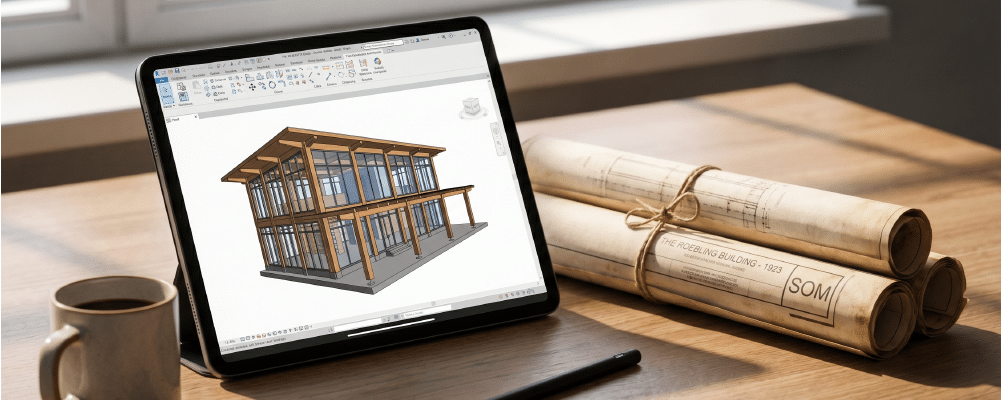
Let us be completely honest about the current state of the U.S. real estate and construction market: handing a multi-million-dollar developer a stack of flat, 2D blueprints today is a lot like handing them a flip phone to run their business. Sure, it technically works, but it is entirely missing the smart technology, predictive data, and interconnected systems needed to get the job done efficiently and profitably.
Enter Building Information Modeling. While a surprising number of industry professionals still think of this methodology merely as standard “3D modeling,” the reality is infinitely more powerful. It is an intelligent, highly collaborative, data-rich process that evolves across multiple layers of depth. For modern architects, custom home builders, and commercial developers, mastering the various BIM dimensions is the ultimate key to preventing disastrous on-site clashes, accurately predicting volatile material budgets, and delivering sustainable, future-proof buildings that buyers actually want.
Before we dive into the deep end, let us clear up a common industry misconception. Many professionals still confuse the overarching methodology of Building Information Modeling with the specific software programs used to execute it. If you are still untangling those concepts or wondering which tool does what, our comprehensive breakdown on What is the Difference Between BIM vs Revit in Architectural Design? is an absolute must-read before you move forward with your digital transformation.
What are BIM Dimensions?
Building Information Modeling (BIM) extends far beyond standard 3D modeling. BIM Dimensions refer to the specific layers of data linked to an intelligent 3D model to enhance project understanding and management.
By integrating additional parameters, such as time, cost, sustainability, and facility management, project teams gain deeper insights. This multidimensional approach enables better decision-making, improved collaboration, and increased efficiency throughout the entire lifecycle of a building, from its initial concept to its final demolition.
Now let us break down the BIM dimensions, tracing the journey from initial 3D visualization all the way to 7D facility management. Along the way, we will explore exactly why understanding all 7 dimensions of BIM is revolutionizing the AEC (Architecture, Engineering, and Construction) industry across the United States.
1. 3D BIM: The Spatial Dimension (Visualization & Clash Detection)
This is where the magic starts and where the foundation of all BIM dimensions is laid. 3D BIM takes the traditional X and Y coordinates of a standard floor plan and adds the critical Z-axis for depth. But here is the kicker: unlike a simple, “dumb” 3D render used purely for visual flair, a 3D BIM model is packed to the brim with parametric data.
In this environment, a wall is not just a grey rectangle drawn on a screen. The intelligent model knows that it is a 6-inch reinforced concrete wall, complete with specific thermal resistance properties, load-bearing capabilities, and manufacturer specifications.
- For Architects & Interior Designers: This dimension allows for stunning architectural visualization and spatial exploration before a single brick is ordered or a trench is dug. You can walk clients through the space in virtual reality, adjusting sightlines and spatial flow in real-time.
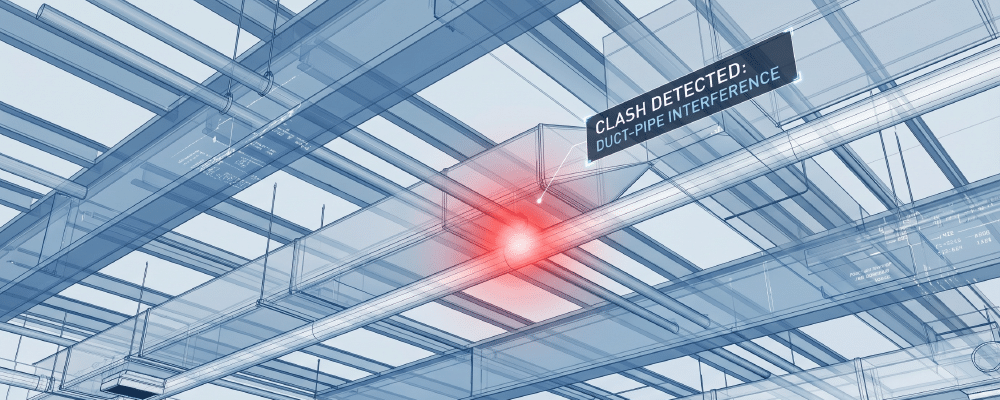
- For Developers & General Contractors: It provides automated, rigorous clash detection. Imagine you are building a luxury high-rise in Miami. The software will literally flag a glowing red warning if a planned HVAC duct is running straight through a structural steel beam or plumbing line. Catching this in the digital realm rather than on the physical job site saves tens of thousands of dollars in rework, labor delays, and material waste.
Ready to eliminate onsite errors? If you are looking for expert clash detection services, Xpress Rendering is here to help. Our team specializes in identifying and resolving spatial conflicts within your 3D models before they reach the field, ensuring a seamless construction process and significant cost savings for your project.
2. 4D BIM: The Time Dimension (Scheduling & Sequencing)
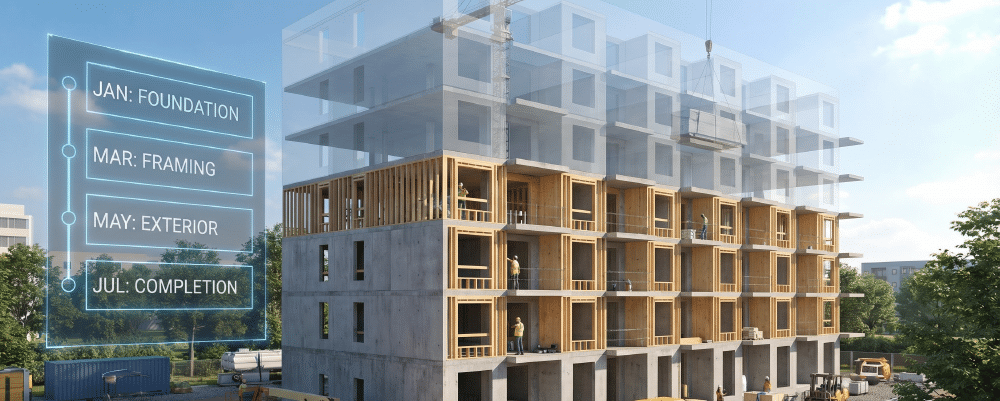
Time is money, especially in U.S. commercial real estate where high interest rates and holding costs can erode a developer’s profit margin by the day. Stepping into the temporal side of the BIM dimensions, 4D BIM integrates project scheduling data directly into the 3D model.
Imagine having the ability to watch a highly accurate time-lapse video of your building being constructed, step-by-step, week-by-week, before the actual construction even begins. That is the power of the fourth dimension.
- The Benefit: It visually communicates the entire construction sequence. Instead of staring at an endless, complex Gantt chart on a spreadsheet, stakeholders can actually see the foundation being poured in week two, the steel framing going up in week five, and the drywall installation happening in week ten.
- The Impact on the Job Site: Project managers can proactively optimize site logistics. In dense urban environments like New York or San Francisco, where staging areas are minimal, 4D modeling allows contractors to foresee bottleneck delays and ensure that materials arrive exactly when they are needed for installation. This “Just-In-Time” delivery method keeps the project strictly on schedule and prevents materials from sitting out in the weather or cluttering the workspace.
3. 5D BIM: The Cost Dimension (Estimating & Budgeting)

If the fourth dimension represents time, the fifth dimension is all about your budget. Out of all the BIM dimensions, this one arguably gets developers and investors the most excited. 5D BIM directly ties the intelligent components of the 3D model to real-time, dynamic cost data. As the architectural design evolves and changes, the project budget updates automatically.
- How it Works in Practice: Let us say an interior designer decides to change the flooring specification from standard laminate to a high-end luxury hardwood across a massive 50-unit residential complex. In a traditional workflow, an estimator would spend days recalculating quantities and making phone calls for new pricing. With 5D integration, the model instantly recalculates the square footage, applies the new material cost, factors in the altered labor requirements, and presents the new total cost in seconds.
- The Unmatched Value: According to extensive research and guidelines set forth by the National Institute of Building Sciences (NIBS), implementing robust modeling standards across a project lifecycle can significantly reduce project contingencies, drastically limit change orders, and prevent devastating budget overruns. For Realtors and developers, this provides unparalleled financial predictability, ensuring that the promised ROI at the start of the project remains intact at the finish line.
4. 6D BIM: The Sustainability Dimension (Energy Analysis)

We are currently operating in an era where ESG (Environmental, Social, and Governance) goals are paramount, and U.S. building regulations are tightening aggressively year over year. From California’s strict Title 24 energy codes to New York’s Local Law 97, building green is no longer a niche trend—it is the law. As we explore the 3D to 7D BIM spectrum, the 6th dimension focuses entirely on the building’s environmental impact, energy performance, and long-term sustainability.
- The Eco-Advantage for Modern Architecture: 6D BIM empowers architects and engineers to run complex simulations long before construction. They can analyze how natural sunlight will hit the building throughout the year, simulate how heat will be retained during winter, and precisely calculate how much energy the HVAC system will consume over the next thirty years.
- Streamlining LEED Certification: For developers aiming for prestigious LEED, WELL, or Energy Star certifications, integrating this layer of data is indispensable. It proves the building’s peak efficiency on paper, allowing stakeholders to make informed decisions about installing solar panels, upgrading insulation, or changing window glazing to hit their target metrics long before the city inspectors arrive.
5. 7D BIM: The Lifecycle Dimension (Facility Management)

A building’s life does not magically end when the ribbon is cut and the grand opening party finishes; realistically, that is just day one of a decades-long journey. The final stage of our core BIM dimensions journey is 7D, which hands over a fully loaded, data-rich “digital twin” to the property owners and facility managers.
- Playing the Long Game: This dimension aggregates all the critical operational data gathered during the design and construction phases. It includes warranty information, manufacturer details, preventive maintenance schedules, vendor contacts, and technical specifications for literally every tangible asset inside the building.
- A Real-World Scenario: Picture this: a crucial water pump in the basement of a commercial office building breaks down in year five. Without 7D data, the facility manager has to dig through dusty filing cabinets or hundreds of disorganized PDF folders to find the manual. With a 7D digital twin, they simply open the model on a tablet, click on the broken pump, and instantly see the exact manufacturer, the specific replacement part number, the installation date, and whether the warranty is still active. It turns reactive, chaotic maintenance into a streamlined, proactive science.
The 3D to 7D BIM Dimensions Comparison Table
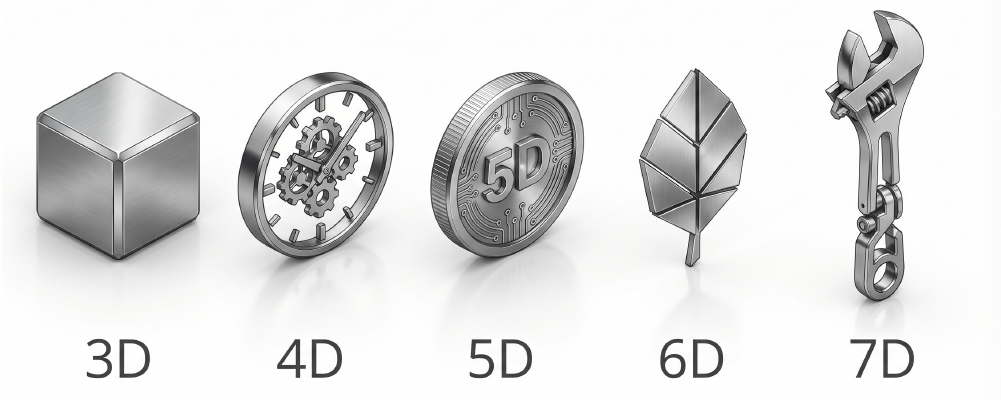
To help you digest how these layers build upon one another, we have developed a clear comparison of the BIM dimensions explained in this guide. This proprietary Xpress Rendering breakdown illustrates the progression from basic geometry to total lifecycle mastery.
| Dimension | Focus Area | Primary Output / Goal | Key Beneficiaries |
|---|---|---|---|
| 3D BIM | Spatial Geometry | Parametric modeling, visual spatial coordination, and automated clash detection. | Architects, Designers, Engineers, Clients |
| 4D BIM | Time & Scheduling | Construction sequencing, logistics planning, and visual schedule optimization. | General Contractors, Project Managers |
| 5D BIM | Cost & Budgeting | Automated quantity takeoffs, real-time cost estimation, and budget tracking. | Developers, Estimators, Investors |
| 6D BIM | Sustainability | Energy consumption analysis, daylight simulation, and LEED compliance tracking. | Sustainability Consultants, Architects |
| 7D BIM | Facility Management | Creation of a digital twin, lifecycle management, and maintenance scheduling. | Facility Managers, Property Owners, Realtors |
Frequently Asked Questions (FAQs) About BIM Dimensions
-
What are the BIM dimensions explained simply?
BIM dimensions refer to the progressive layers of specific data integrated into a digital building model. Think of them as levels of intelligence: 3D adds spatial geometry, 4D incorporates project scheduling (time), 5D integrates financial cost estimation, 6D analyzes energy usage and sustainability, and 7D focuses entirely on post-construction facility management and lifecycle tracking.
-
Why are BIM dimensions so crucial for U.S. real estate developers?
Understanding and utilizing these dimensions, particularly 4D and 5D, allows developers to mitigate massive financial risks. 5D automates cost estimation by linking the 3D model directly to material quantities and real-time pricing. If a design changes mid-project, the budget updates instantly. This prevents nasty financial surprises and allows developers to maintain tight control over their Return on Investment (ROI).
-
What is the core difference between 3D, 4D, and 5D BIM?
It all comes down to the type of data being attached to the building geometry. 3D BIM focuses purely on the physical design, spatial layout, and identifying physical clashes. 4D BIM takes that exact 3D model and maps it against the construction schedule (adding the element of time). 5D BIM takes it a step further by adding financial data to estimate the exact cost of the materials and labor required over that specific timeline.
-
How do the 7 dimensions of BIM help with achieving LEED certification?
The 6D BIM dimension is specifically tailored for this. It allows architects to perform deep energy consumption analysis, thermal tracking, and natural daylight simulations entirely during the digital design phase. This hard data is critical for proving a building’s sustainability metrics, which is a strict requirement to achieve high-tier LEED or WELL certifications in the United States.
-
What does 7D BIM actually mean for property managers and Realtors?
For property managers, 7D BIM provides a functioning “digital twin” of the completed building. Instead of paper binders, the digital model holds all operation and maintenance (O&M) manuals, active warranty data, and asset replacement schedules. For Realtors, having a 7D model is a massive selling point, as it proves to prospective buyers that the building is technologically advanced and highly efficient to operate.
-
Is utilizing all BIM dimensions only necessary for large commercial skyscrapers?
Not at all. While massive U.S. developers effectively mandate comprehensive modeling for commercial projects due to the high financial risks involved, custom home builders, residential architects, and boutique developers are increasingly using 3D, 4D, and 5D BIM. They use these dimensions to eliminate residential construction errors, optimize complex interior design layouts, and drastically speed up the municipal permit approval process.
BIM Dimensions Conclusion: Elevating Your Projects with Data-Driven Design

Fully grasping the BIM dimensions explained above is just the first step in modernizing your approach to real estate and construction. The real, tangible competitive advantage comes from flawless implementation. Whether you are an ambitious architect striving for absolute zero-clash designs, a seasoned developer fiercely guarding your profit margins with 5D cost tracking, or a commercial Realtor looking to leverage 7D data to increase a property’s valuation, adopting a comprehensive modeling workflow is no longer optional. In the U.S. market, it is the new industry standard.
However, navigating the complex world of BIM dimensions can be daunting, and you certainly do not have to build these highly technical, data-heavy models alone. Partnering with a specialized, experienced team ensures your architectural data is perfectly accurate, meticulously optimized, and ready to be leveraged across every single dimension.
If you are ready to streamline your next major construction project, eliminate costly on-site errors, reduce your timeline, and radically elevate your architectural visualization, it is time to take action. Explore our professional BIM Services at Xpress Rendering today. Our dedicated experts will help you seamlessly transition your traditional blueprints into intelligent, actionable, and highly profitable digital assets.