Let’s be real for a second: construction errors happen. It’s the nature of the beast when you bring together hundreds of workers, thousands of materials, and tight deadlines. But when it comes to the legalities of building design, errors are often the most expensive aspect of the job. As architects, developers, realtors, and builders navigating the wild world of US real estate, we know that tearing up freshly poured concrete or relocating plumbing rough-ins absolutely kills project margins.
The cold, hard truth is that the earlier accessibility problems are identified, the easier and less costly they are to resolve. If your team is working on a commercial build, a mixed-use development, or a public facility, full compliance is not a “nice to have”, it is legally required.
Unfortunately, ADA Compliance Mistakes are alarmingly common, leading to delayed openings, massive retrofit costs, and stressful litigation. To help you protect your bottom line, keep your stakeholders happy, and build better, more inclusive spaces, we are going to dive deep. Here are the six most common ADA compliance mistakes design teams make, and exactly how you can avoid them.
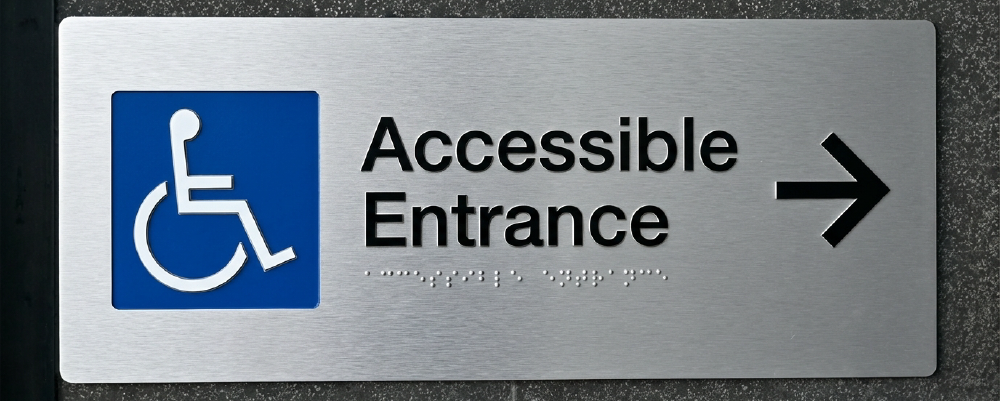
ADA Compliance Mistake #1: Failing to Recognize All Applicable Laws and Codes
One of the most frequent mistakes made in accessible design is assuming that the Americans with Disabilities Act (ADA) is the only set of accessibility requirements that applies to a project. If you are operating under this assumption, you are walking into a minefield.
Accessibility compliance is a layered, highly complex system. Depending on your funding sources, your specific jurisdiction, and the building’s end-use, your project might also be subject to the Fair Housing Act (FHA), the Architectural Barriers Act (ABA), or much stricter state and local municipal codes. In fact, if your project touches federal funding in any way, shape, or form, it almost always triggers the ABA.
As an example, a multifaceted project involving public entities, housing elements, and mixed funding could simultaneously fall under:
- The Americans with Disabilities Act (ADA)
- The Architectural Barriers Act (ABA)
- The Rehabilitation Act of 1973 (Sections 5 0 4 and 508)
- The Fair Housing Act (FHA)
- The Civil Rights Restoration Act
- State accessibility codes (which may be stricter than federal requirements)
- Local accessibility amendments or building codes
Architects and developers who overlook these distinct regulatory layers expose both themselves and their clients to substantial legal and financial risk. The last thing you want as a developer or a builder is to pass your local inspection only to get slapped with a federal lawsuit.
Pro Tip: Always check the official ADA Design Standards as your baseline. However, you must cross-reference your specific funding sources early in the design phase! True ADA compliant architecture requires a holistic view of every rulebook your project falls under.

ADA Compliance Mistake #2: Ignoring the “High-Risk” Zones (A Quick Ticket to ADA Compliance Failures)
If you don’t understand where your areas of risk are, you cannot mitigate them. It sounds simple, but you would be shocked at how many seasoned professionals miss the obvious traps.
Because new construction is held to the absolute highest standard by the Department of Justice, errors in the design phase expose the project to immediate and significant liability. Unlike existing historical facilities where you might have some wiggle room, new work has no “readily achievable” defense. Simply put: it must comply, no excuses.
Another major trap that leads directly to ADA Compliance Mistakes? Not addressing accessibility issues just outside your official scope of work. Imagine you are building a beautiful new commercial plaza, and your property line ties into an existing, non-compliant public sidewalk. Many builders assume, “Not my property, not my problem.” Wrong.
If your new build ties into a non-compliant public path of travel, you need to cover your bases. Document the issue with photos and reports, notify the property owner or the city immediately, and clearly state in your official project record that this specific condition is outside your control and scope. Protect your license and your wallet.

ADA Compliance Mistake #3: Assuming “Close Enough” Is Good Enough
Let’s talk about the tape measure. The ADA Standards are incredibly precise, and in new construction, there is zero allowance for “almost compliant.” You either meet the requirement, or you do not. A government inspector with a digital level does not care that you tried your best.
This “close enough” mentality shows up constantly in two highly visible areas, causing some of the most frustrating ADA compliance mistakes in the industry:
The Signage Trap
Signs should always be on the wall on the latch side of doors. Why? Because if a person who is blind or has low vision has to search for a tactile sign on a door that happens to be swung open, it defeats the purpose entirely. They might have to step into a room uninvited just to read the room number. It’s bad user experience and a clear code violation.
The Accessible Parking Nightmare
Every single component of an accessible parking space must be fully compliant. This means a maximum 2% slope in any direction (running slope and cross slope). Contractors often eyeball the grade, and the asphalt settles at 2.4%. Close enough, right? Absolutely not. That 0.4% difference means you are ripping up the lot and repaving. When it comes to parking, close enough is not compliant. Period.
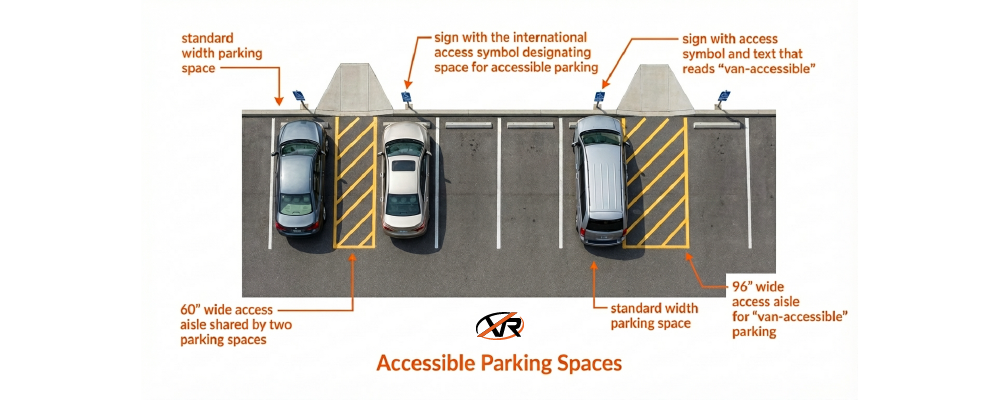
ADA Compliance Mistake #4: Misunderstanding Accessible Route Requirements
When we talk about an ADA-accessible route, most design teams immediately think about width. Yes, the code dictates that an ADA-accessible route is required to be a minimum of 36 inches wide. But true ADA compliant architecture isn’t just about the horizontal clearance; it is heavily dependent on the surface material itself.
Accessible surfaces must be firm, stable, slip-resistant and without large gaps or openings. While those rustic cobblestones or deep-grooved pavers might look fantastic on your mood board, they are a nightmare for accessibility. Poorly detailed surfaces or excessive grout lines can create harmful vibrations, making it incredibly uncomfortable and difficult for someone in a wheelchair or using a walker to travel over them.
Furthermore, under 28 CFR 35.133, accessibility features must be kept in operable working condition. This means the ongoing maintenance of these routes is a legal requirement. If your beautiful pathway is prone to heaving, cracking, or pooling water, you are setting the property owner up for future ADA compliance mistakes.

ADA Compliance Mistake #5: Catching Accessibility Issues Too Late in the Game
Too often, accessibility issues are discovered when the architect hands over the 100% Construction Documents (CDs), or worse, after the framing is already up and the concrete is poured. By then, corrections are brutally costly, timelines are blown, and the project’s risk exposure is sky-high.
The absolute key to preventing ADA failures architecture is establishing a rigid internal review process during the schematic design phase, and absolutely no later than the 50% Design Development (DD) phase. You cannot wait until the end to “check for ADA.”
Here are some best practices for reducing accessibility issues:
- Assign an accessibility expert and make sure they have a professional liability insurance, extensive accessibility experience and accreditations or credentials, such as APA Certified, Built Environment (APAC-BE) certification from the Accessibility Professionals Association.
- Establish an internal process that provide early inspections for accessibility and Conduct structured reviews at SD, 5 0 % DD, and 100% CD.
By leveraging advanced technology early in the design phase, you can spot these precise spatial issues before breaking ground. When your team collaborates in a digital environment, finding a hallway that is two inches too narrow is a quick click of a mouse, rather than a $20,000 demolition job.
For a real-world look at how early coordination saves headaches, check out our comprehensive guide on How Architects Use BIM & 3D Rendering to Streamline a Mixed-Use Development. (Spoiler alert: detecting clashes digitally is the ultimate stress reliever for any project manager).

ADA Compliance Mistake #6: Not Understanding the Core Mission of the ADA
We can get so bogged down in the math, the 36 inches, the 2% slopes, the 18-inch pull-side door clearances, that we forget why we are doing this. Accessibility is ultimately about civil rights, independence, and providing an equal user experience for all. It is not just about technical compliance; it is about human dignity.
If a building features a beautiful, fragrant garden path meant for employees to relax on their lunch break, the accessible route must also go through the flowers, not around them, behind the dumpsters, or below them in a concrete tunnel.
We see this misaligned decision-making all the time: placing accessible parking on the far north side of a building, while the only accessible entry ramp is located on the exact opposite south side. This requires a person with a mobility disability to travel an undue, exhausting distance just to access the front door.
When the full design and construction team understands the human goals behind the rules, not just the technical requirements, the project has a dramatically better chance of being fully compliant. Design for people, and the math usually follows.

How BIM Services Bulletproof Your ADA Compliance
Let’s face the facts: spotting a 2% slope failure, an improper door swing, or a structural pinch-point in a massive, cluttered 2D floor plan is incredibly difficult, even for the most seasoned architects and developers. Human error is a reality. That’s exactly where the experts at Xpress Rendering step in to save the day.
By utilizing our intelligent BIM Building Services, developers, builders, and architects can virtually construct their entire building before a single shovel hits the dirt. This isn’t just about pretty pictures; this is about data-driven construction.
Our highly detailed BIM models allow your team to run comprehensive clash detection and verify precise spatial requirements in a 1:1 digital environment. We are talking about automated ADA compliance checking BIM workflows that can visually flag a hallway that dips below 36 inches of clearance, or a restroom grab bar that conflicts with a plumbing chase.
Finding an ADA compliance failure in a BIM model costs zero dollars to fix. Finding that same error during the final building inspection costs thousands of dollars and weeks of delays.
Don’t leave your accessibility compliance to chance in the field. Protect your margins, protect your clients, and build spaces that truly welcome everyone. Get a Quote today and let our BIM experts help you build smarter, safer, and fully compliant projects.
Frequently Asked Questions (FAQs) About ADA Compliance Mistakes in Construction
As experts in the field, we hear the same questions pop up from realtors, developers, and builders across the country. Here is a quick cheat sheet to keep you informed.
-
Who is ultimately responsible for ADA compliance on a construction project?
While the design team (architects and engineers) and the general contractors execute the work, the building owners are ultimately held legally responsible when noncompliance occurs. However, owners will frequently pull the architects and contractors into resulting litigation to recoup their losses, making it a massive shared liability.
-
Are the ADA Standards the only rules I need to follow for accessibility?
No. Depending on your project’s funding, jurisdiction, and use case, you may also need to strictly comply with the Architectural Barriers Act (ABA), the Fair Housing Act (FHA), or specific state and local municipal building codes (which are often stricter than the federal ADA).
-
Can I claim that making a new building fully ADA-compliant is “too difficult” or “too expensive”?
No. In new construction, there is absolutely no “readily achievable” defense. You are legally expected to provide access to the maximum extent feasible from day one. Financial hardship is generally only a defense for retrofitting older, existing historical buildings.
-
What is the maximum allowable slope for an accessible parking space?
Accessible parking spaces and their adjoining access aisles must have a maximum 2% slope in any direction. This includes the running slope, the cross slope, and the diagonals.
-
How wide must an interior ADA-accessible route be?
An ADA-accessible route must be a minimum of 36 inches wide. It can legally narrow to 32 inches at a door or a specific pinch point, but that narrowing can only last for a maximum length of 24 inches before it must open back up to 36 inches.
-
How can my architectural team catch ADA compliance mistakes earlier in the process?
The best practice is to begin dedicated accessibility reviews no later than the 50% Design Development (DD) phase. Utilizing intelligent BIM (Building Information Modeling) services allows your team to visualize clearances, turning radiuses, and slopes in true 3D, catching potential violations during the digital design phase rather than during costly field construction.
-
Does the ADA dictate what amenities I have to build?
No. The ADA does not tell you what to build (like a pool, a rooftop bar, or a garden). However, the law states that whatever amenities you do choose to offer must be made available to everyone without creating a lesser, segregated, or secondary experience for individuals with disabilities.
Conclusion About ADA Compliance Mistakes
At the end of the day, avoiding ADA compliance mistakes isn’t just about memorizing a massive federal rulebook; it’s about integrating smart, proactive workflows into your design and construction phases. By understanding the layered laws, respecting the precise measurements, and leveraging modern BIM technology early in the process, you can eliminate the costly rework that plagues so many job sites. Build smart, build inclusive, and let the technology do the heavy lifting for you.