Summary: For US real estate developers, architects, and builders, late-stage construction conflicts are notorious budget-drainers. This comprehensive guide explores how transitioning from outdated 2D plans to advanced Scan to BIM workflows eliminates costly MEP clash detection issues, accelerates municipal approvals, and protects project ROI across nationwide adaptive reuse developments and modern commercial builds.
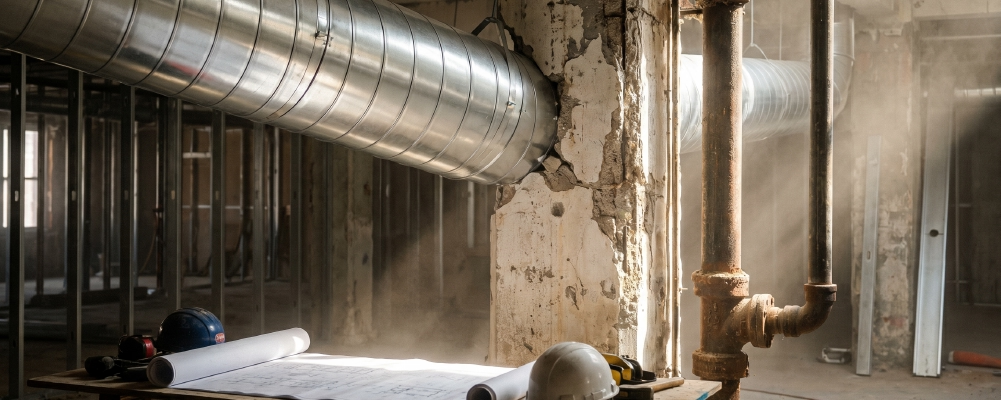
Picture this: Your high-profile commercial retrofit in downtown Chicago is right on schedule. The structural reinforcements are complete, the drywall is ready to go up, and the mechanical contractors are on-site, fully prepared to install the new, state-of-the-art HVAC system. But when the multi-thousand-dollar custom ductwork arrives on the floor, it collides directly with an undocumented, legacy plumbing riser completely hidden above the drop ceiling.
Progress instantly halts. Requests for Information (RFIs) start flying across desks. Rework costs skyrocket, and your carefully planned timeline goes out the window.
For architects, developers, and general contractors across the United States, late-stage mechanical, electrical, and plumbing (MEP) clashes are the ultimate margin-killers. According to data from industry authorities like the Construction Industry Institute (CII), rework typically consumes 4% to 6% of a total project’s value. In MEP-heavy renovations or complex adaptive reuse developments, that number climbs exponentially as labor and material costs compound.
But what if you could foresee, navigate, and entirely eliminate every single spatial conflict before a single piece of sheet metal is cut or a pipe is laid? Enter the ultimate risk-mitigation tool for modern construction: Scan to BIM.
Here is exactly how leveraging precise laser scanning and intelligent 3D BIM modeling is transforming MEP coordination from a reactive, stressful nightmare into a proactive, predictable science for the US real estate and construction sectors.
The High Cost of Guesswork in Traditional MEP Coordination
Historically, architecture, engineering, and construction (AEC) professionals have relied heavily on 2D as-built drawings and manual tape measurements to coordinate renovations, retrofits, and massive adaptive reuse developments. The inherent problem with this approach is that buildings are living, breathing entities. Over decades of use, contractors reroute pipes for quick fixes, owners drop ceilings to hide aging infrastructure, and virtually nobody updates the original blueprints to reflect these physical changes.
Relying on outdated 2D drawings creates a breeding ground for project-derailing clashes. When teams work in silos with fragmented information, three distinct types of conflicts inevitably emerge on the job site:
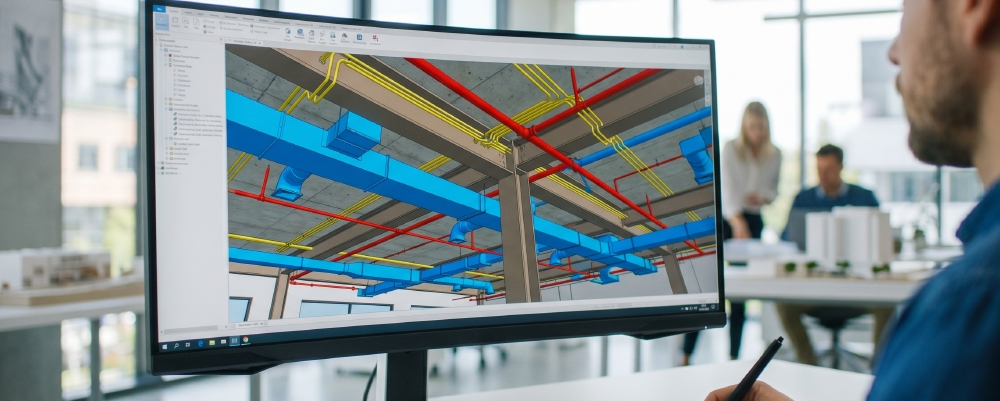
- Hard Clashes: These are absolute physical intersections where two or more elements attempt to occupy the exact same spatial coordinates. A classic example is a heavy structural steel I-beam cutting directly through the path of a required ventilation duct, or a plumbing pipe routed through an electrical cable tray. These are catastrophic for schedules.
- Soft Clashes: These occur when elements do not physically touch, but they violate spatial tolerances, maintenance buffers, or strict US building codes. For instance, an electrical panel might be placed in a corridor without the required OSHA clearance space for a technician to safely perform future maintenance. While not a physical collision, a soft clash will fail an inspection just as quickly.
- Workflow (4D) Clashes: These are scheduling and logistical conflicts where the sequence of construction creates devastating bottlenecks. An example would be heavy mechanical machinery blocking the only installation path for essential plumbing, requiring teams to undo completed work just to grant access to another trade.
When you attempt to build a modern 3D model based on highly inaccurate 2D historical data, your MEP clash detection software is simply coordinating a fantasy. To build with confidence, you need to model reality. That is where the Scan to BIM process becomes indispensable.
What is Scan to BIM? (And Why US Developers Are Mandating It)
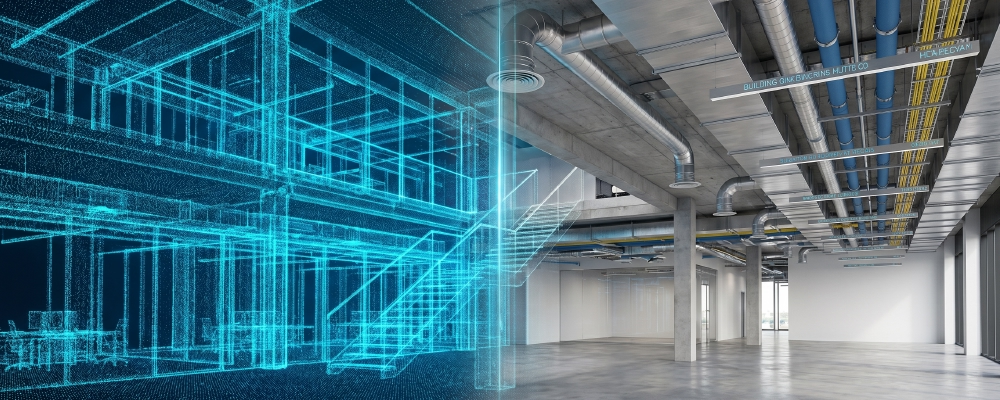
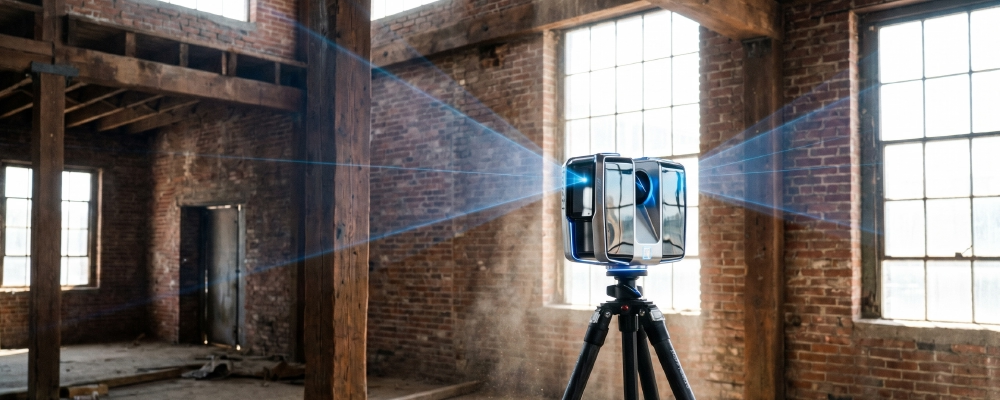
Scan to BIM is the highly methodical process of using advanced 3D laser scanners (often utilizing LiDAR technology) to capture the exact, real-world physical conditions of an existing space. The scanner spins rapidly, bouncing millions of light beams off all surrounding surfaces (floors, walls, exposed pipes, ceiling joists) creating a hyper-accurate, millimeter-precise digital representation known as a “Point Cloud.”
This massive set of raw data is then imported into sophisticated architectural software, such as Autodesk Revit. From there, expert virtual design teams utilize the point cloud to BIM workflow, meticulously tracing over the millions of data points to create an intelligent, data-rich 3D BIM modeling environment.
Organizations like the National Institute of Building Sciences (NIBS) and the US National BIM Program continually emphasize the critical importance of accurate digital twins for the lifecycle of a building. By utilizing a Scan to BIM workflow, you aren’t merely modeling what the legacy, coffee-stained blueprints say is there; you are modeling what actually exists on the site today.
For realtors and developers, having this level of accuracy is a game-changer. It means you can confidently pitch a property’s potential, knowing the underlying structural and mechanical constraints have been accurately mapped. Scan to BIM completely removes the blindfold from the design and development process.
How Scan to BIM Bulletproofs MEP Clash Detection
Integrating point cloud data into your MEP coordination workflow completely shifts the battlefield. Instead of solving highly complex engineering problems on a dusty construction site while a crane rents by the hour, you solve them virtually, in a climate-controlled office, months before breaking ground.
Here is how the Scan to BIM methodology creates an impenetrable shield against construction errors:
1. Visualizing the Invisible Complexities
Modern laser scanners can capture plenum spaces, tight mechanical mezzanines, and complex riser shafts in full, immersive 360-degree views. By revealing undocumented structural offsets, sagging beams, and legacy mechanical sleeves that no one knew existed, your MEP modelers gain a true lay of the land. They can strategically route new HVAC, plumbing, and electrical systems around actual, measured obstacles, completely eliminating surprise hard clashes from the equation.
2. Millimeter-Level Precision for Soft Clashes
Top-tier laser scanning regularly achieves an astonishing ±2 to 5 millimeter accuracy. This remarkable precision allows dedicated BIM coordination services to run highly sensitive clearance checks. Using advanced Revit clash detection alongside federated model platforms like Navisworks or Solibri, the software can automatically flag soft clashes. If your newly designed, high-efficiency HVAC unit is missing the required 3-foot maintenance clearance from an existing structural column, the software flags it instantly, allowing the design team to pivot before purchasing the equipment.
3. Smarter, Faster Data Management
There is one caveat: a heavy, incredibly detailed point cloud integrated with architecture, structure, and complex MEP systems can easily bog down a standard computer, turning your workflow into a sluggish, frustrating process. However, top-tier BIM professionals know exactly how to manage this dense data efficiently to keep the coordination process fast and agile.
If your architectural firm or in-house design team struggles with slow, crashing models during the crucial clash detection phase, it is vital to optimize your software environment. Check out our comprehensive, step-by-step guide on 11 Best Practices for Managing Large BIM Models in Revit to streamline your workflow and keep your projects running at peak performance.
The Real-World ROI of Scan to BIM for Modern Builds
Adopting new technology always comes with questions about the bottom line. But for nationwide US developers, home builders, and elite architectural firms, the return on investment of Scan to BIM is undeniably clear and highly lucrative.
Zero Field Rework and Wasted Materials
Think about the hourly rate of an entire mechanical contracting crew standing idle on a job site while a clash is resolved. Now compare that to the cost of a BIM coordinator sliding a digital pipe six inches to the left on a computer screen. Resolving a clash in Navisworks costs a few hours of an engineer’s time. Resolving it on-site costs thousands of dollars in wasted materials, labor, and heavy machinery rentals. Scan to BIM ensures that what gets modeled is exactly what gets built.
Faster Zoning and Stakeholder Approvals
When you approach a strict city zoning board or a group of high-net-worth investors, confidence is everything. Presenting a clash-free, highly detailed 3D model (often enhanced by stunning US architectural rendering techniques) builds immediate, unshakeable trust. It proves that your team has done the due diligence, mapped the exact site conditions, and mitigated the risks. This level of professionalism routinely accelerates the green light on major projects.
Seamless Off-Site Prefabrication
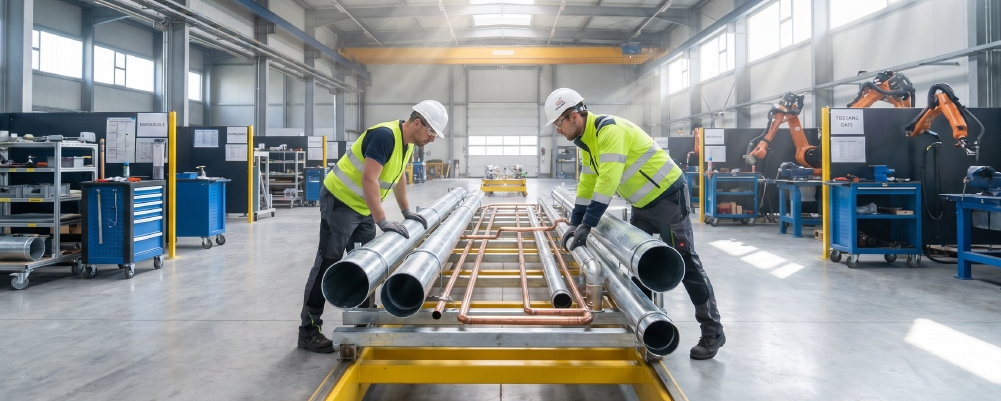
The construction industry is rapidly moving toward off-site prefabrication to save time and reduce waste. However, prefabrication only works if the measurements are absolutely flawless. Because a Scan to BIM model is millimeter-accurate, MEP contractors can confidently prefabricate massive ductwork segments and complex pipe spools in a controlled factory environment. They simply ship the finished pieces to the site and bolt them together perfectly, effectively reducing field labor by up to 30% and drastically shrinking the construction schedule.
Elevate Your Next Project with Expert BIM Coordination Services
Navigating the sheer complexities of modern architecture requires significantly more than just owning a copy of good software; it requires a deep, intuitive understanding of spatial relationships, strict adherence to US building standards, and a commitment to flawless execution. Whether you are a developer erecting a luxury high-rise in Miami, an architect leading a massive adaptive reuse project in Detroit, or an interior designer mapping out complex commercial spaces in Los Angeles, you simply cannot afford to leave your MEP coordination to chance.

At Xpress Rendering, we do not just draw lines on a screen. We support leading developers, builders, and architectural firms nationwide with state-of-the-art virtual design and construction solutions. We seamlessly transform complex point clouds and ambitious architectural visions into clash-free, highly coordinated 3D models that fiercely protect your timeline, your reputation, and your budget.
Are you ready to stop guessing and start building with absolute, mathematical certainty?
Explore Our Expert BIM Services for Your Next Project
Scan to BIM: Frequently Asked Questions (FAQs)
As Scan to BIM becomes the gold standard for construction in the US, we hear many of the same questions from our clients. Here are the answers you need to understand this transformative process.
1. What is the main difference between traditional 3D BIM modeling and Scan to BIM?
Traditional 3D BIM modeling often involves building a digital representation of a project from scratch or relying on historical 2D architectural plans, which may be vastly outdated. Scan to BIM, on the other hand, uses physical laser scanning hardware to capture the actual, existing real-world conditions of a site. This creates a highly accurate point cloud, which is then used as the flawless foundation to build the 3D BIM model.
2. How exactly does Scan to BIM improve MEP clash detection?
By providing millimeter-accurate measurements of existing conditions, Scan to BIM ensures that all new Mechanical, Electrical, and Plumbing (MEP) designs are coordinated against reality, not against optimistic or outdated blueprints. This proactively prevents new systems from colliding with hidden, shifting, or undocumented existing structural elements.
3. What software is the industry standard for BIM clash detection?
While Autodesk Revit is the dominant software used for the actual point cloud to BIM modeling phase, programs like Autodesk Navisworks and Solibri are the undisputed industry standards for running complex clash detection algorithms. These sophisticated programs federate (combine) models from different design disciplines to identify precise geometric and clearance conflicts.
4. Can the Scan to BIM process accurately detect “Soft Clashes”?
Yes, absolutely. Because the laser-generated point cloud data is incredibly precise, BIM coordination software can be programmed with specific rules to detect soft clashes. A soft clash occurs when a physical element violates a required spatial buffer, such as the mandatory operational clearance space around an electrical panel or the required airflow gap around an HVAC unit.
5. Is Scan to BIM worth the upfront cost for mid-sized real estate developments?
Without a doubt. The initial cost of deploying a laser scanner and paying for professional point cloud to BIM modeling is vastly outweighed by the massive financial savings gained from preventing on-site rework. Catching even a single major hard clash in the MEP coordination phase can easily pay for the entire Scan to BIM service package tenfold.
6. Do you provide BIM coordination services for developers and architects across the USA?
Yes. Digital construction and comprehensive BIM coordination services are entirely location-independent. Our expert team can process raw laser scan data, execute rigorous Revit clash detection, and deliver fully coordinated, clash-free 3D models to developers, architects, and home builders anywhere nationwide. Learn more here.
Implementing a robust Scan to BIM strategy is no longer a futuristic luxury; it is a fundamental necessity for profitable, on-time construction. Don’t let hidden clashes dictate your project’s success. Take control of your building’s data today.