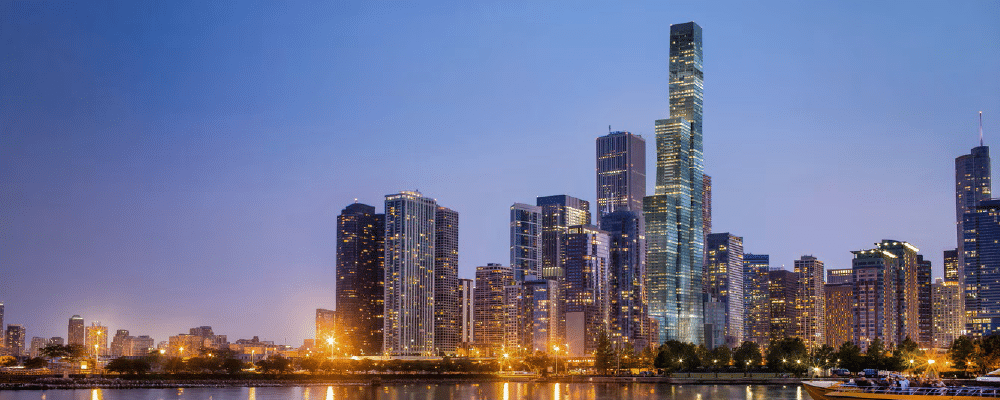
Picture this: You are standing on the edge of the Chicago River, looking up at a skyline that basically invented the modern skyscraper. This is the city of steel frames, the birthplace of the commercial high-rise, and a testing ground for structural innovation. But even in a city dominated by legendary, broad-shouldered giants like the Willis Tower and the John Hancock Center, a new silhouette has completely rewritten the visual rules of the grid. We are talking about the completion of a supertall that makes rigid rectangles look entirely out of date.
Chicago is the birthplace of the modern skyscraper, but the completion of the St. Regis Chicago (formerly Vista Tower) redefined the city’s architectural vocabulary. This case study explores the intersection of aesthetic fluidity and rigorous structural engineering that makes this supertall a modern masterpiece.
If you are an architect pushing the boundaries of geometry, a developer crunching the numbers on luxury mixed-use spaces, a builder figuring out how to pour concrete at over a thousand feet in the air, or a realtor selling the ultimate sky-high lifestyle, the St. Regis Chicago Architecture holds invaluable lessons. Let us peel back the curtain wall and see how this undulating marvel actually stands up to the infamous midwestern gales, maximizes real estate value, and sets a new benchmark for global high-rise design.
St. Regis Chicago Architecture, Project Quick Facts: The Blueprint of a Giant
Before we dive into the complex engineering and the mesmerizing aesthetics of the facade, we need to establish the baseline metrics that make this project a staggering achievement in urban development.
-
Official Name: The St. Regis Chicago (formerly Vista Tower)
-
Location: 363 E Wacker Dr, Chicago, IL (Lakeshore East neighborhood)
-
Height: 1,191 feet (363 meters) – Proudly standing as the 3rd tallest building in Chicago
- Building Size: 1,884,416 sf/ 175,068 m2
-
Stories: 101 stories
- Construction Start: 2016
-
Completion Year: Completed in 2021
-
Lead Architect: Jeanne Gang from Studio Gang
-
Architect of Record: bKL Architecture
-
Developer: Magellan Development Group
-
Primary Function: Luxury Residential (Condominiums) & 5-Star Hotel / 393 condominiums and 191 hotel rooms.
Decoding the Frustum: A Masterclass in Geometric St. Regis Chicago Architecture
When you look at the Chicago skyline today, your eyes are immediately drawn to a structure that seems to ripple like a ribbon caught in an updraft. The defining characteristic of the St. Regis Chicago Architecture is its stepped, undulating profile. Designed by the visionary team at Studio Gang, the structure steps away from traditional box-like forms and instead relies on a captivating geometric shape known as the “frustum.”
For those dusting off their high school geometry books, a frustum is essentially a pyramid with its top chopped off. Imagine taking that shape, flipping it upside down, and stacking it on top of a right-side-up frustum. Now, repeat that process dozens of times across three interconnected towers of varying heights. That is the structural secret sauce of this building. By utilizing alternating frustums, Jeanne Gang and her team created a continuous flowing form that shifts depending on where you are standing in the city.
But let’s be real, in the world of high-stakes development, you do not build a 1,191-foot tower just because a shape looks cool. Every design choice must serve a functional, economic, or structural purpose. This geometry is not merely aesthetic; it vastly improves the building’s aerodynamic performance, disrupting wind forces that typically challenge supertall structures.
Furthermore, from a developer’s perspective, this unique stacking method creates multiple “corner” rooms. In luxury real estate, corner units with panoramic views command a premium price per square foot. The frustum design essentially multiplies the number of high-value corner residences, proving that brilliant St. Regis Chicago Architecture is as much about maximizing return on investment as it is about dominating the skyline.
Defeating the “Windy City”: Structural Engineering at 1,191 Feet
Any seasoned builder or developer working in the Midwest knows that gravity is only your second biggest enemy when constructing a supertall. Your primary adversary is the wind. Designing a monumental Chicago Building means going to war with vortex shedding, the phenomenon where high winds hit a flat surface and create alternating vortices of low pressure on the sides, causing the building to sway violently.
The St. Regis Chicago Architecture tackles this problem through sheer structural ingenuity. The undulating frustums naturally confuse the wind, preventing those organized, destructive vortices from forming. However, geometry alone is not enough to keep a 101-story building perfectly still during a January blizzard.
At the heart of the tower is a massive, incredibly robust reinforced concrete core. This spine anchors the building, but the real magic happens higher up. If you look closely at the tallest tower from street level, you might notice something peculiar near the crown: a section that appears slightly darker or completely empty. This is Floor 83, famously known as the “blow-through floor.”
Leaving a floor completely unoccupied and open to the elements in a luxury high-rise might sound like a developer’s nightmare, after all, that is prime, sellable square footage left on the table. But the Magellan Development Group understood the necessary trade-off. This blow-through floor acts as a pressure relief valve. When harsh winds hit the upper echelons of the tower, the air literally blows straight through the 83rd floor, significantly reducing the aerodynamic sway and the structural stress on the lower levels.
To add an final layer of comfort for the ultra-wealthy residents at the top, engineers implemented a tuned mass damper system. Unlike traditional solid steel pendulums used in other skyscrapers, this system utilizes massive water sloshing tanks.
If the wind pushes the building a few inches to the east, the thousands of gallons of water in the tanks slosh to the west, counteracting the movement in real-time. This combination of aerodynamic geometry, a blow-through floor, and liquid mass dampers ensures that the St. Regis Chicago Architecture remains rock solid, keeping the chandeliers still and the residents perfectly comfortable.
The Gradient Glass Façade: Materiality Meets Nature in St. Regis Chicago Architecture
An architectural masterclass in structural engineering means nothing if the exterior envelope fails to captivate. For interior designers, realtors, and architectural visualization artists, the facade of this building is an absolute playground of light, color, and texture.
The curtain wall of the tower is not a monolithic sheet of reflective silver or standard corporate black. Instead, the St. Regis Chicago Architecture employs a highly sophisticated gradient glass system.
The architects meticulously selected six distinct shades of high-performance glass. The frustums that flare outward, meaning the glass is tilted slightly downward toward the street, utilize the darkest shades of blue. Why? Because these outward-leaning sections catch the most direct sunlight. The darker, heavily coated glass acts as a natural visor, reducing solar heat gain and minimizing the glare for the residents inside. Conversely, the frustums that tilt inward, facing up toward the sky, use the lightest, most transparent shades of glass to maximize daylight penetration into the living spaces.
This gradient effect does two things brilliantly. First, it optimizes the thermal efficiency of the interior, lowering HVAC costs and contributing to the building’s sustainability goals. Second, it creates a breathtaking visual illusion. The shifting hues of blue perfectly mimic the multifaceted surface of Lake Michigan on a sunny day. As the sun moves across the Chicago skyline from dawn to dusk, the building appears to change color, shimmering and reflecting the environment around it.
It is a stunning example of how materiality can connect a massive urban monolith back to the natural world.

Harmonizing High-Rise Luxury: An Interior and Development Perspective
Let us shift our focus from the exterior engineering to the interior experience. If you are a realtor or an interior designer, the value of a property is ultimately dictated by how it feels to live inside it. The St. Regis Chicago Architecture delivers an interior experience that completely redefines high-rise luxury.
One of the most significant triumphs of the building’s structural design is the near-total elimination of perimeter columns. Because the structural loads are brilliantly managed by the central concrete core and the exterior frustum geometry, the living spaces are not interrupted by bulky, view-blocking pillars. This allows for massive, floor-to-ceiling windows that wrap seamlessly around the units, offering unobstructed, 360-degree panoramic views of Lake Michigan, Navy Pier, Millennium Park, and the sprawling urban grid below.
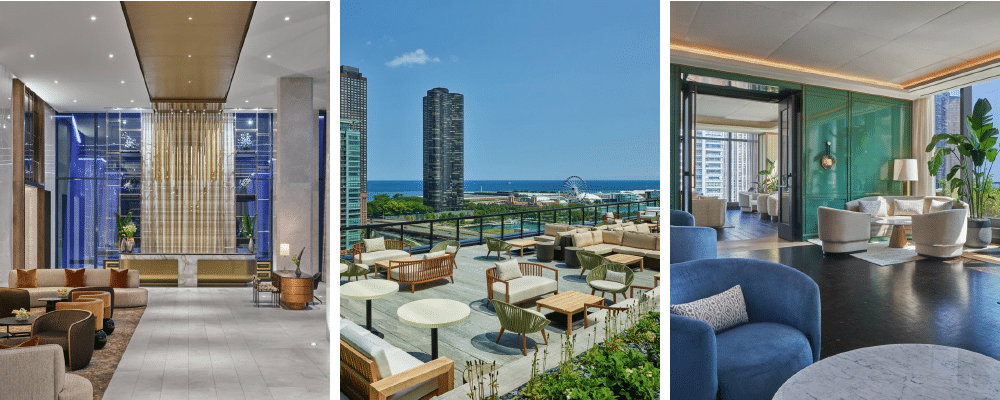
The mixed-use nature of the building also presented unique design challenges that were flawlessly executed. The lower floors house a world-class 5-Star St. Regis Hotel, requiring distinct lobby spaces, grand ballrooms, and luxury amenity decks. As the building rises into the narrower frustums, it transitions into ultra-luxury residential condominiums. The undulating exterior means that almost no two floor plans are exactly alike.
For interior designers, this offers a unique canvas, a break from the repetitive, cookie-cutter layouts found in standard luxury towers. For realtors, it means every unit has a unique selling proposition, a distinct angle, and a bespoke feel that justifies top-tier market pricing.
From Chicago to Miami: The Evolution of Supertall Stacking
The profound impact of the St. Regis Chicago Architecture extends far beyond the borders of Illinois. The innovative use of stacked geometries to manipulate form, increase corner units, and mitigate wind resistance is becoming a hallmark of modern luxury developments across the entire country. Developers and home builders are realizing that architectural daring translates directly into market dominance.
Just as developers in Florida are pushing their own structural boundaries with offset cubic volumes to combat hurricane-force winds, as we explored deeply in our recent article, Waldorf Astoria Miami Architecture Insights: Engineering South Florida’s First Supertall, Chicago’s St. Regis proves that daring structural engineering can coexist perfectly with ultra-luxury living.
We are witnessing a national architectural renaissance where the structural skeleton of the building is the aesthetic. Whether it is the undulating frustums in the Midwest or the stacked, gravity-defying glass cubes in Miami, the era of the boring box is officially over.
Visualizing the Future: Bring Your Next Masterpiece to Life
Understanding the genius behind the St. Regis Chicago Architecture is one thing; pitching a concept of that magnitude to investors, zoning boards, and early buyers is an entirely different battle. Translating complex structural geometries like inverted frustums, gradient glass facades, and intricate interior layouts into a compelling visual narrative is a monumental challenge.
For developers, architects, and real estate professionals aiming to secure critical investments, city approvals, or pre-construction sales, presenting your vision with absolute, breathtaking clarity is non-negotiable. You cannot sell a billion-dollar skyline-altering dream with a flat 2D blueprint.
Whether you are conceptualizing a dynamic supertall, planning a sprawling residential community, or refining the ultimate luxury interior layout, our professional 3D Rendering Services bring your architectural plans to life with photorealistic precision long before the foundation is even poured. We specialize in capturing the exact play of light on complex facades, the texture of premium materials, and the emotional resonance of a space. Do not leave your next masterpiece to the imagination.
Connect with Xpress Rendering today to elevate your next project presentation and close the deal, get a quote for your project here.
Frequently Asked Questions (FAQs) About St. Regis Chicago Architecture
To wrap up this structural case study, we have compiled the most common questions industry professionals and architecture enthusiasts ask regarding this modern marvel.
-
Who is the architect of the St. Regis Chicago?
The St. Regis Chicago was designed by acclaimed architect Jeanne Gang, founder of the world-renowned Studio Gang. This monumental achievement makes it the tallest building in the world designed by a woman. Additionally, bKL Architecture served as the highly respected Architect of Record, ensuring the execution of the complex design.
-
How tall is the St. Regis Chicago building?
The skyscraper stands tall at an impressive 1,191 feet (363 meters). It contains 101 stories above ground, firmly securing its place as the third-tallest building in the iconic Chicago skyline, just behind the Willis Tower and the Trump International Hotel and Tower.
-
Why does the St. Regis Chicago have an empty floor?
Floor 83 of the St. Regis is a purposefully designed, unoccupied “blow-through” floor. This is a highly advanced structural engineering technique. It allows harsh, high-altitude winds to pass entirely through the building’s profile, significantly reducing the aerodynamic sway and vortex shedding that plague supertall towers.
-
What was the St. Regis Chicago formerly known as?
During its extensive design and early construction phases, the project was officially known and heavily marketed as the Vista Tower. It was officially rebranded as the St. Regis Chicago in 2020 after an agreement was reached to bring the luxury hospitality brand into the development.
-
Why are there different colors of glass on the St. Regis facade?
The St. Regis Chicago Architecture utilizes six distinct shades of blue glass to highlight its undulating frustum geometry while improving energy efficiency. Darker glass is strategically used on surfaces that tilt outward to provide natural solar shading and reduce glare, while lighter, more transparent glass is used on inward-tilting surfaces to maximize natural light for the residents.
-
Is the St. Regis Chicago a residential or commercial building?
It is a mixed-use luxury development. The lower floors of the towers house a premier 5-star St. Regis Hotel, complete with world-class dining and amenities. The middle and upper floors consist entirely of ultra-luxury residential condominiums, offering some of the most exclusive and expensive real estate in the American Midwest.
St. Regis Chicago Architecture Conclusion: Keep Looking Up
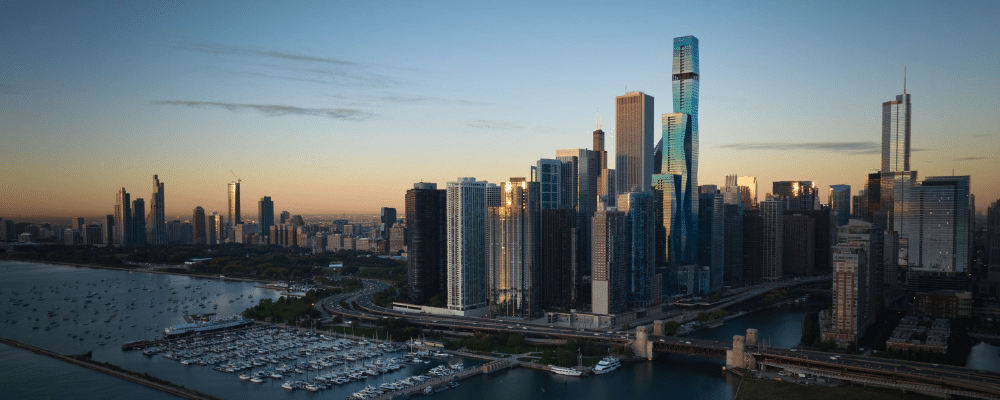
The St. Regis Chicago is far more than just a stunning new silhouette on the horizon; it is a masterclass in pushing the absolute limits of what is structurally and aesthetically possible in modern high-rise design. From its ingenious frustum geometry that gracefully handles the midwestern winds to the meticulously designed gradient glass that reflects the natural beauty of Lake Michigan, every inch of this supertall tower offers a valuable lesson in visionary development.
If you found this structural case study insightful, the conversation does not have to end here. At Xpress Rendering, we are passionate about exploring the intersection of design, engineering, and visual storytelling. We constantly update our blog with in-depth articles, industry insights, and architectural deep-dives tailored specifically for architects, home builders, ambitious developers, and top-tier realtors across the United States.
Make sure to bookmark our blog and check back frequently. We are always sharing fresh, high-value content designed to help you stay ahead of the curve in the highly competitive world of real estate and architectural design. Whether you are looking for the latest structural trends, deep dives into iconic buildings, or strategies to elevate your next massive project pitch, we have you covered.