The world of architecture has always been divided into two distinct eras: before Zaha Hadid, and after.
If you work in this industry, whether you are drafting blueprints in a high-rise studio in Chicago, pouring concrete for a custom build in Texas, or closing luxury deals in Miami, you should know that “Zaha” isn’t just a name. It’s a shorthand for a complete paradigm shift.
On March 31, 2016, the design world stopped. We didn’t just lose a celebrity; we lost the woman who fundamentally reinvented the mathematics of space. But before she was the globally recognized Dame Zaha Hadid, she was something else entirely. She was the “Paper Architect.”
For decades, the establishment dismissed her. Critics looked at her defying, gravity-mocking sketches and said three words that haunt every ambitious designer: “This is unbuildable.” They were wrong.
Today, we are going to take a deep dive into the mind of the “Queen of the Curve.” We aren’t just looking at pretty pictures; we are going to dissect the logic, the business case, and the sheer audacity that allowed Zaha Hadid to bend reality.
The Architect Who Bent Reality
It is hard to imagine now, looking at the skylines of Beijing, Rome, or Miami, that there was a time when Zaha Hadid was the industry’s greatest underdog.
In the 1980s and early 90s, her firm was famous for winning competitions and equally famous for never getting anything built. Her designs were too radical, too aggressive, and frankly, too scary for the conservative boards of directors writing the checks. She famously had her winning design for the Cardiff Bay Opera House rejected, twice.
But Zaha didn’t pivot. She didn’t simplify her lines to make the builders happy. Instead, she waited for the technology to catch up to her imagination.
Her thesis was simple but revolutionary: Life is not made in a grid.
If you look at nature, you rarely see a perfect 90-degree angle. Rivers flow, dunes shift, and landscapes undulate. Zaha Hadid believed our buildings should do the same. She didn’t just want to design a shelter; she wanted to manipulate the very ground the building stood on. She treated concrete and steel as if they were fluid, creating structures that looked like they were frozen in mid-motion, mere seconds away from exploding or melting.
When she finally broke through, she didn’t just open a door; she kicked it off the hinges for every woman in the industry, becoming the first female architect to win the Pritzker Prize in 2004. But to understand how she did it, we have to go back to the beginning. We have to talk about math.
The Foundation: Math, Art, and Suprematism
Most architects start their journey with a sketchbook. Zaha Hadid started hers with a calculator.
Born in Baghdad in 1950, her first academic love wasn’t design; it was mathematics. She studied it at the American University of Beirut before she ever set foot in the Architectural Association in London. This is the secret sauce that many people miss. When Zaha looked at a void in a city, she didn’t just see a construction site; she saw complex algorithms and topological surfaces.
But here is where the story gets fascinating for the creatives reading this. How do you communicate complex mathematical algorithms before the invention of advanced 3D modeling software?
You paint them.
The Artistic Link to Architecture
In the early days of her career, 2D technical drawings were useless to Zaha. An elevation or a floor plan couldn’t capture the multi-perspective, anti-gravity chaos she was envisioning. So, she turned to abstract painting as a primary design tool.
She wasn’t painting to hang art in a gallery; she was painting to figure out how a building could exist. She treated the canvas as a testing ground for architectural space.
Her greatest influence came from a surprising place: The Russian Avant-Garde, specifically an artist named Kazimir Malevich. Malevich was the pioneer of Suprematism, an art movement focused on basic geometric forms—squares, circles, lines, painted in a limited range of colors. But for Zaha, Suprematism was about more than shapes; it was about “anti-gravity.”
Malevich’s work floated in white space, unanchored by the horizon. Zaha Hadid took this concept and applied it to heavy construction materials. She asked a question that terrified engineers: Why does a building have to look like it’s sitting on the ground? Why can’t it look like it’s floating?
She used painting to “explode” the building, fragmenting the perspective to see it from all angles at once. This artistic foundation is why her early work feels so raw and energetic. She was literally painting the future before she could build it.
If you want to see how this artistic vision translates into the massive global firm operating today, you can explore the current portfolio on the official Zaha Hadid Architects website. You will see that while the tools have changed, the DNA remains the same.
The Evolution: From Deconstructivism to Parametricism
For the builders and engineers reading this, this is the section where the rubber meets the road. Zaha Hadid’s career isn’t just one style; it’s a technological evolution that mirrors the advancement of the construction industry itself.
We can divide her career into two distinct phases: The Sharp and The Smooth.
Phase 1: Deconstructivism (The Sharp)
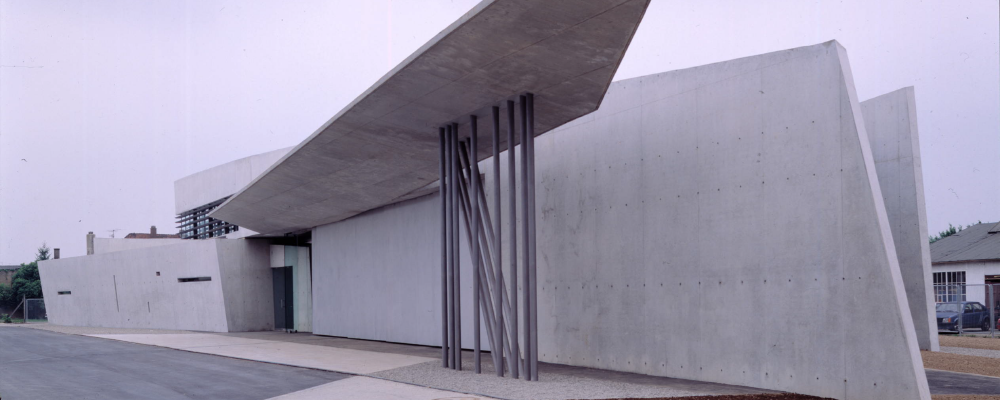
The project that finally silenced the “Paper Architect” critics was the Vitra Fire Station in Weil am Rhein, Germany, completed in 1993.
If you look at this building, there isn’t a curve in sight. It is a masterpiece of Deconstructivism. It is sharp, angular, and aggressive. It looks like a pane of glass that has been shattered and frozen in time.
Zaha described this project perfectly: “The whole building is frozen motion ready to explode into action at any moment.”
It was a functional building, a fire station, but she treated it as a study in tension. The walls tilt, the canopy slices through the sky, and the lines force your eye to move rapidly across the structure. It was brilliant, but it was still defined by angles.
Phase 2: Parametricism (The Smooth)
As we moved into the 2000s, computers caught up. The introduction of advanced algorithms allowed Zaha Hadid to partner with Patrik Schumacher and pioneer a new style: Parametric Design (or Parametricism).
This was the shift from “shards” to “liquid.”
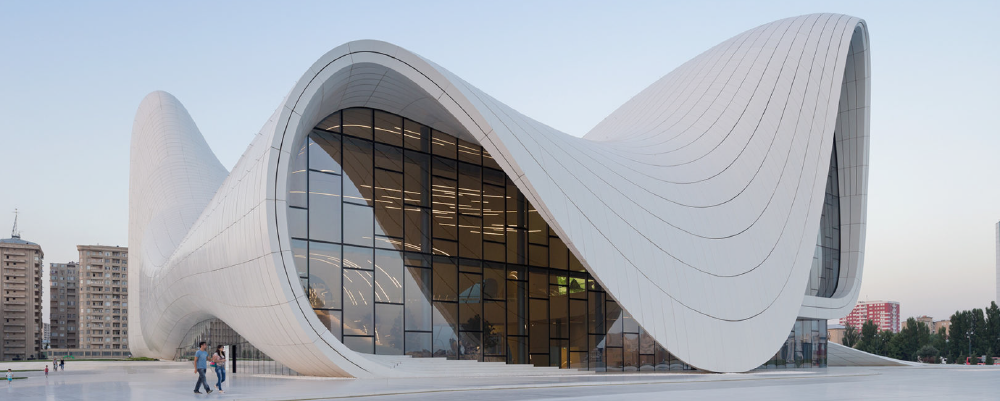
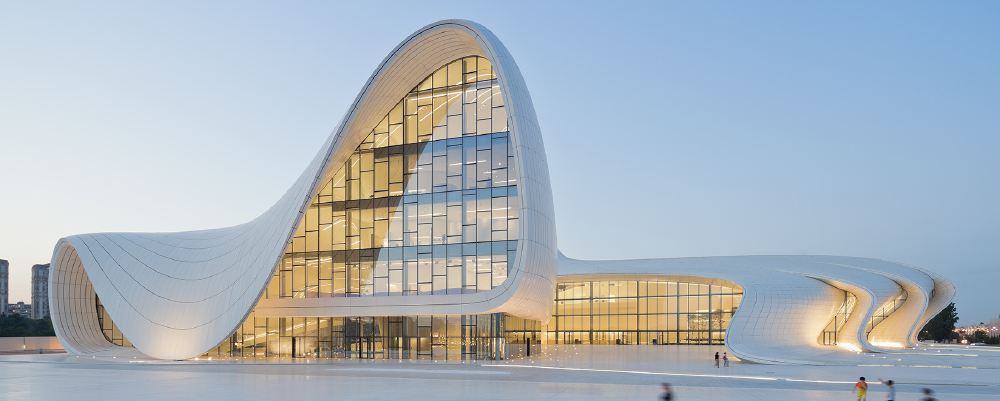
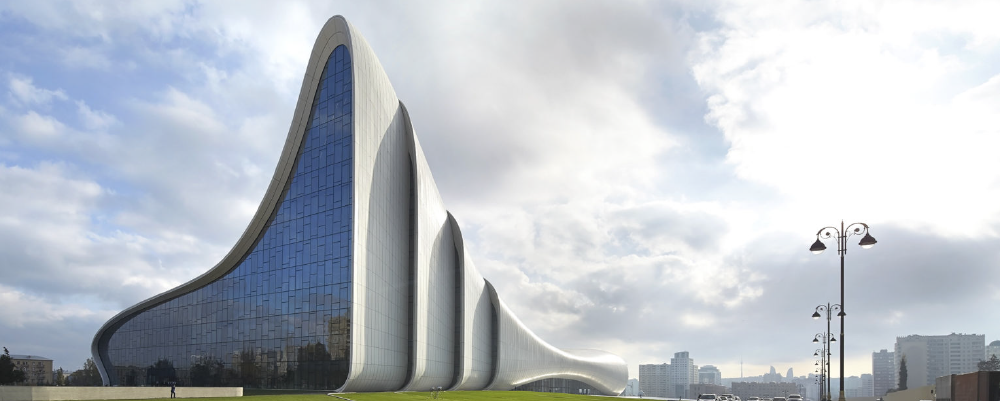
The ultimate example of this is the Heydar Aliyev Center in Baku, Azerbaijan. If you have ever tried to model a complex surface in Revit or Rhino, you know how difficult it is to make a roof merge seamlessly into a wall and then into the ground.
In Baku, Zaha Hadid Architects achieved the impossible. There is no distinction between the building and the landscape. The plaza rises up to become the building, wraps around to form the roof, and flows back down. It creates a continuous, fluid skin.
The Tech Behind the Curves
For the general contractors out there, you know this nightmare: How do we build this?
Zaha’s shift to Parametricism forced the construction industry to innovate. You couldn’t build the Heydar Aliyev Center with standard pouring methods. It required:
-
Space Frame Structures: Massive engineering feats to support the skin without internal columns cluttering the view.
-
Glass Fibre Reinforced Concrete (GFRC): Using advanced composite materials that could be molded into complex curves while remaining lightweight.
-
Digital Fabrication: The use of CNC milling and 3D printing to create the molds for the panels, ensuring that every single customized piece fit together like a giant 3D puzzle.
She didn’t just design a weird shape; she forced the entire supply chain to get smarter.
The Business Case: The “Zaha Effect” on Real Estate
Let’s switch hats for a moment. If you are a Developer or a Realtor, you might be thinking: Art is great, but does it sell?
The answer is a resounding yes. It’s called the “Zaha Effect.”
In the world of high-end real estate, architecture is the ultimate differentiator. When Zaha Hadid attached her name to a project, it didn’t just become a building; it became a collectible asset, like a Picasso or a Rothko.
Case Study: One Thousand Museum, Miami
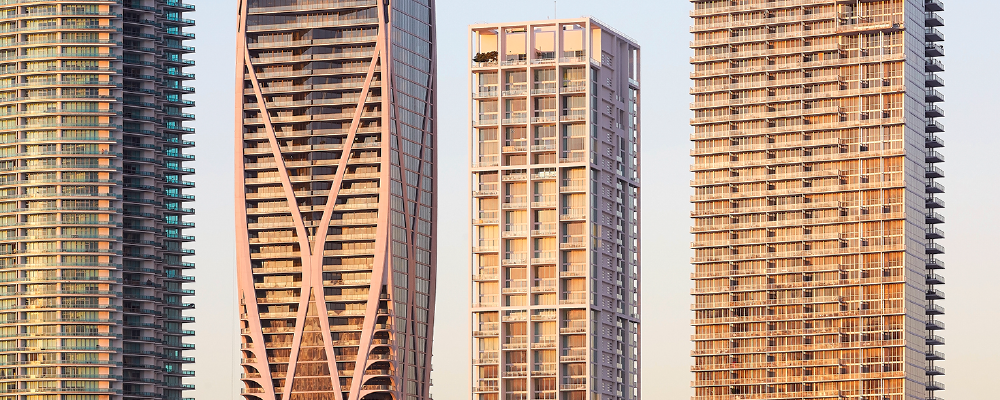
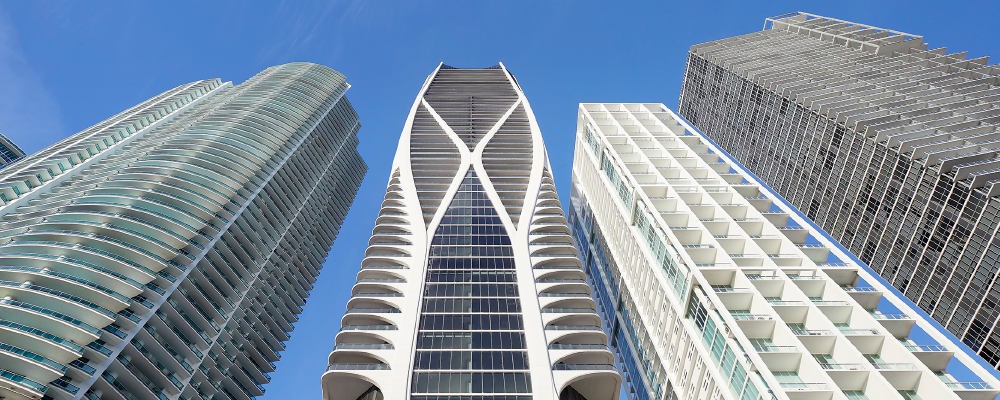
Let’s look at One Thousand Museum in Miami, one of her final projects completed posthumously in 2020. This is the first residential tower ZHA designed in the Western Hemisphere.
Miami is full of luxury glass boxes. To compete, you need something that stops traffic. Zaha designed a tower with a structural “exoskeleton”—curving concrete supports that snake their way up the outside of the building.
Here is the brilliant business move hidden inside that design:
By pushing the structural support to the exterior (the exoskeleton), she eliminated the need for massive internal columns.
-
The Design Win: The building looks like an alien artifact, instantly becoming the most recognizable tower on the Biscayne skyline.
-
The Business Win: The interiors are completely column-free. This allowed the developers to sell “half-floor” and “full-floor” residences with uninterrupted 360-degree views.
Zaha Hadid proved that bold, difficult geometry isn’t just an ego trip for the architect; it creates tangible value per square foot. It turns a condo into a trophy.
Contextualizing Legacy: Zaha vs. The Masters
It is easy to view Zaha Hadid as a futurist who had nothing to do with the past, but that isn’t entirely true. She is part of a lineage of architects who refused to be trapped by the “box.”
While she used algorithms and GFRC, she shares a spiritual DNA with the American master of Organic Architecture. Both believed that a building should be integrated with its environment, not just placed upon it.
While Zaha Hadid looked to the future with algorithms to achieve this integration, the roots of organic design run deep in architectural history. It’s a fascinating evolution from the analog to the digital. You can read more about how the American pioneer of this philosophy changed the game in our article on Why Frank Lloyd Wright’s Legacy Still Shapes American Home Design to see where these philosophies diverge and where they intersect.
Zaha took the “organic” concept, which was traditionally about wood, stone, and nature, and translated it into the digital age. She made concrete feel organic. She made steel feel like a living organism.
The Challenge: Visualizing the Impossible
Here is the reality for the developers and architects reading this today.
Zaha Hadid was a genius, but she also struggled for decades because people couldn’t see what she was talking about. She had to paint abstract art because the CAD tools of the 1980s couldn’t handle her vision. She lost competitions because clients couldn’t read her complex 2D drawings.
Today, you face a similar challenge. You might have a vision that breaks the mold. You might want to use parametric design to maximize a difficult lot, or you might have a renovation idea that completely transforms a space.
But if your investors, your city council, or your buyers can’t see it, they won’t buy it.
In the modern era, you don’t need to be an abstract painter to sell your vision. You need a visualization partner who understands geometry, light, and material physics. Complex curves are notoriously difficult to render—if the lighting isn’t perfect, they look fake. If the texture isn’t mapped correctly, the illusion breaks.
Don’t let your boldest ideas remain “unbuildable” on paper like Zaha’s early work. At Xpress Rendering, we specialize in translating complex architectural geometry into photorealistic visuals. We speak the language of the curve. Explore our 3D Rendering Services to bring your vision to life before you even pour the first footer.
FAQs About Zaha Hadid
Here are the most common questions we get asked about Zaha Hadid and her impact on modern architecture.
-
What is Zaha Hadid’s architectural style called?
Zaha Hadid is most associated with Parametricism (using algorithms to create fluid forms) in the latter half of her career. Her earlier work is defined as Deconstructivism, characterized by sharp angles, fragmentation, and a feeling of “controlled chaos.” She was famously nicknamed the “Queen of the Curve.”
-
How did Zaha Hadid change architecture?
She liberated architecture from the “box.” She proved that using advanced computer-aided design (CAD), buildings could have complex, continuous geometries that mimic nature. She shifted the industry focus from rigid functionality to emotional, fluid spatial experiences, proving that concrete structures could appear weightless.
-
Why was Zaha Hadid called a “Paper Architect”?
In the early decades of her career, many of her designs—such as The Peak in Hong Kong—won prestigious competitions but were considered too complex, expensive, or radical to actually build. She proved the critics wrong with the completion of the Vitra Fire Station in 1993, transitioning from theory to reality.
-
Did Zaha Hadid design furniture?
Yes. Her studio extended her “fluid” philosophy to interior design. She created limited-edition furniture tables that looked like melting ice, jewelry, shoes, and even superyachts. Her design philosophy was holistic; she believed the curve should extend from the building structure down to the fork you eat with.
-
What was Zaha Hadid’s first building?
Her first major built project was the Vitra Fire Station in Weil am Rhein, Germany, completed in 1993. It remains an icon of the Deconstructivist style.
-
What is the significance of One Thousand Museum in Miami?
It was one of her final projects and her first residential tower in the Western Hemisphere. It features a unique structural “exoskeleton” that curves up the exterior of the building. This design choice allowed for open, column-free floor plans, maximizing the real estate value of the interiors.
-
How does Zaha Hadid’s work relate to Russian art?
Hadid was deeply influenced by Suprematism and the Russian avant-garde artist Kazimir Malevich. She used his concepts of fragmentation, floating forms, and anti-gravity in her early paintings to help her visualize architectural space in ways that traditional drafting could not.
-
Are Zaha Hadid’s buildings sustainable?
While known for aesthetics, many of her firm’s later works integrate advanced environmental modeling. For example, the Bee’ah Headquarters uses parametric design to minimize energy consumption by regulating sunlight and airflow, proving that high-design can also be eco-friendly.
How Zaha Hadid Legacy Will Continue
Zaha Hadid taught the world a lesson that goes far beyond architecture: limitations are often just a failure of imagination.
She looked at a rigid, male-dominated industry obsessed with right angles and forced it to embrace the curve. She took the “unbuildable” and built it, proving that with enough passion and mathematical precision, concrete can indeed float.
For the architects, developers, and builders reading this today, her legacy is a reminder that the safe choice is rarely the one that makes history. Whether you are designing a single-family home or a city skyline, the “Zaha Effect” proves that bold geometry and innovative vision don’t just create beautiful structures, they create lasting value.
The future of design is fluid, and thanks to Zaha, we now have the courage to flow with it.